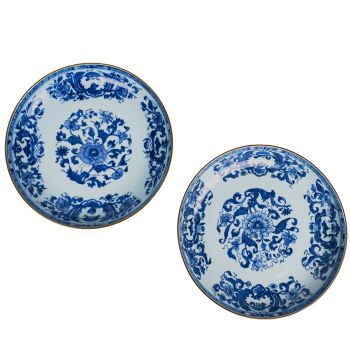
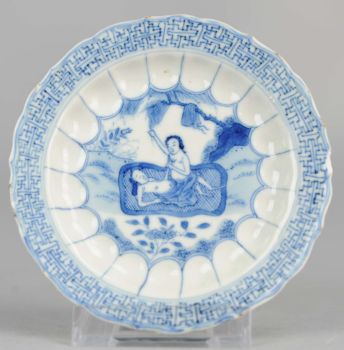
A pair of inscribed blue and white ‘Wild Goose Pagoda’ dishes for the Japanese market, Ko-Sometsuke, 1621 - 1672
Artista Desconhecido
PorcelanaPorcelana chinesa
ø 21 cm
ConditionGood
Preço em pedido
Menken Works of Art
- Sobre arteA pair of inscribed blue and white ‘Wild Goose Pagoda’ dishes for the Japanese market, Ko-Sometsuke.
Ming dynasty, Tianqi Period (1621–1627).
The central scene depicts three geese standing in the foreground, with a fourth goose flying above them. Next to this scene appears a four-character inscription that can be translated as: “May your name be inscribed on the wall of the Wild Goose Pagoda in Chang’an.” In the distance, a promontory is shown with a pagoda and a nearby building.
Below this scene, painted upside down, is another four-line verse. This composition gives the impression of a reflection of the pagoda above. The text can loosely be translated as: “May you enjoy the Imperial Spring Banquet in the Apricot Grove.” Beside the inscription is a flowering apricot plant, with three swallows flying above it. The indented cavetto is decorated with a scrolling lotus motif set against a blue ground, while the outer border features a Greek key pattern on a pale blue background.
The first inscription, “May Your Name Be Inscribed on the Wall of the Wild Goose Pagoda in Chang’an,” refers to a tradition that began during the Tang dynasty (618–907). Candidates who successfully passed the highest level of the Jinshi civil service examinations were honored by having their names recorded on the wall of the Wild Goose Pagoda in Chang’an, the capital of the Tang empire.
The second inscription, “May You Enjoy the Imperial Spring Banquet in the Apricot Grove,” alludes to a celebratory banquet traditionally held near the Wild Goose Pagoda for those who had achieved success in the examinations. This message is further emphasized through a visual rebus that combines images of spring swallows with blooming apricot branches, both symbols associated with spring and scholarly achievement.
Diameter 21 cm.
Provenance:
Fa. A.C. Beeling & Zn., Leeuwarden, The Netherlands (sticker on one of the dishes)
Leegstra collection, Warffum, The Netherlands (sticker on both dishes)
Ref:
A similar dish is illustrated in Leaping the Dragon Gate: The Sir Michael Butler Collection of 17th-Century Chinese Porcelain (Katharine Butler, Teresa Canepa, 2021
Also see Four Centuries of Blue and White – The Frelinghuysen Collection of Chinese and Japanese Export Porcelain (Becky Macguire, 2023), p. 304, no. 248.
Another dish is in the Groninger Museum collection, object number 2018.0013.
Worldwide registered and insured shipping.
Inv. No: MW381 - Sobre artista
Pode acontecer que um artista ou criador seja desconhecido.
Algumas obras não devem ser determinadas por quem são feitas ou são feitas por (um grupo de) artesãos. Exemplos são estátuas dos tempos antigos, móveis, espelhos ou assinaturas que não são claras ou legíveis, mas também algumas obras não são assinadas.
Além disso, você pode encontrar a seguinte descrição:
•"Atribuído a …." Na opinião deles, provavelmente uma obra do artista, pelo menos em parte
• “Estúdio de…” ou “Oficina de” Em sua opinião um trabalho executado no estúdio ou oficina do artista, possivelmente sob sua supervisão
• "Círculo de ..." Na opinião deles, uma obra da época do artista mostrando sua influência, intimamente associada ao artista, mas não necessariamente seu aluno
•“Estilo de…” ou “Seguidor de…” Na opinião deles, um trabalho executado no estilo do artista, mas não necessariamente por um aluno; pode ser contemporâneo ou quase contemporâneo
• "Maneira de ..." Na opinião deles, uma obra no estilo do artista, mas de data posterior
•"Depois …." Na opinião deles uma cópia (de qualquer data) de uma obra do artista
• “Assinado…”, “Datado…” ou “Inscrito” Na opinião deles, a obra foi assinada/datada/inscrita pelo artista. A adição de um ponto de interrogação indica um elemento de dúvida
• "Com assinatura ….”, “Com data ….”, “Com inscrição ….” ou “Tem assinatura/data/inscrição” na opinião deles a assinatura/data/inscrição foi adicionada por outra pessoa que não o artista

Você está interessado em comprar esta obra de arte?
Artwork details
Related artworks
Artista Desconhecido
Set Arita 'dog training' plates, 18th century 1700 - 1730
Preço em pedidoVerkoulen Oriental & European Antiques
1 - 4 / 12- 1 - 4 / 6
Artista Desconhecido
Set Arita 'dog training' plates, 18th century 1700 - 1730
Preço em pedidoVerkoulen Oriental & European Antiques
1 - 4 / 24- 1 - 4 / 24
- 1 - 4 / 12