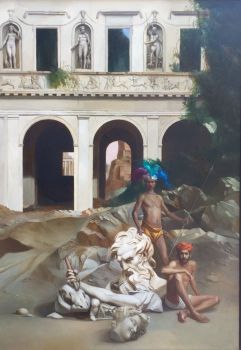
Allegorical Scene of the Lewis and Clark Expedition (1804–1806) Attributed to Léon Cogniet (1794–1880) by Léon Cogniet

Allegorical Scene of the Lewis and Clark Expedition (1804–1806) Attributed to Léon Cogniet (1794–188 1850 - 1870

Léon Cogniet

Óleo sobre tela original
80 ⨯ 110 cm
ConditionGood
Preço em pedido

Spectandum Gallery

  • Sobre arte
    Allegorical Scene of the Lewis and Clark Expedition (1804–1806)
    Attributed to Léon Cogniet (1794–1880)

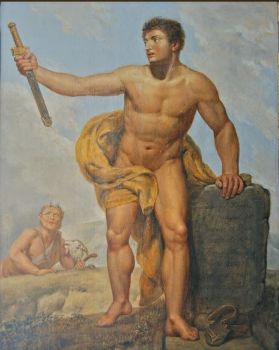
    This ambitious and romanticized composition captures a defining moment in American history: the Lewis and Clark Expedition, commissioned by President Thomas Jefferson to chart a route to the Pacific Ocean through the newly acquired western territories. The painting centers on meticulously rendered figures—Lewis, Clark, Seaman (?), Charbonneau, Sacajawea, and her brother—each embodying the mythos surrounding the legendary journey.

    A student of Pierre-Narcisse Guérin, like Delacroix and Géricault, Léon Cogniet worked during a stylistic transition, moving away from strict Neoclassicism while still retaining elements of it. His early work, Briséis Weeping over Patroclus, though unsuccessful in securing the Prix de Rome in 1815, reveals his classical roots and emerging coloristic sensibility. During his stay in Rome (1817–1822), he painted Castor and Pollux Rescuing Helen, a competition piece with a somber, mannerist tone influenced by Guérin.

    Upon returning to France, Cogniet gained recognition, particularly at the Salon of 1824 with Scene of the Massacre of the Innocents, which marked a departure from the idealized narratives of Neoclassicism. Though he received official commissions and honors such as the Légion d'Honneur, he remained a discreet contributor to major public projects like the Musée de Versailles.

    Highly praised by Baudelaire in 1845, Cogniet's portraits were favored over his historical vignettes. His works are held in various collections, including the Musée des Beaux-Arts d’Orléans. He also created a number of inventive landscape studies, showcasing his versatility and imaginative approach.

    Provenance:
    Marc Arthur Kohn Auctions, Hôtel Le Bristol, Paris, July 2, 2013
    Cornelius Engelen, Leuven, Belgium
    Private Collection, Belgium

    For more detailed information on the Lewis and Clark Expedition, see:
    http://lewisandclarkyearofdiscovery.blogspot.com/2016/
  • Sobre artista

    Léon Cogniet (1794-1880) foi um pintor e professor respeitado francês, conhecido pelas suas cenas históricas, retratos e pelo seu papel influente na arte académica francesa do século XIX.

    Nascido em Paris numa família de artesãos, Cogniet ingressou ainda jovem na École des Beaux-Arts. Aí, estudou com Pierre-Narcisse Guérin e desenvolveu um estilo fortemente enraizado no Neoclassicismo, mas que mais tarde começou a apresentar influências do drama romântico. Em 1817, ganhou o prestigiado Prix de Rome com uma pintura de Aníbal nos Alpes, que lhe valeu uma residência na Villa Medici, em Roma.

    De regresso a França, Cogniet tornou-se um célebre pintor de grandes cenas históricas. Uma das suas obras mais conhecidas é A Execução do Imperador Maximiliano (1827), que demonstra o poder dramático do seu estilo. O seu trabalho era regularmente exposto no Salão e apreciado pelo seu poder composicional, uso controlado da cor e precisão académica.

    Além da sua prática pictórica, Cogniet destacou-se como professor. A partir de 1831, lecionou na École des Beaux-Arts de Paris, onde formou muitos artistas influentes, entre os quais Léon Bonnat e Jean-Paul Laurens. Dirigiu também o seu próprio atelier para artistas femininas entre 1847 e 1860, o que foi excecional para a sua época.

    Nos seus últimos anos, Cogniet largou o pincel para se dedicar inteiramente ao ensino. O seu estilo caiu em desuso com a ascensão do realismo e do impressionismo, mas o seu contributo para a tradição académica e para o seu trabalho pedagógico permaneceram de grande importância.

    Léon Cogniet faleceu em Paris em 1880. As suas obras encontram-se hoje em coleções que incluem o Louvre, o Museu de Orsay e o Museu de Belas Artes de Nantes.

Você está interessado em comprar esta obra de arte?

Artwork details