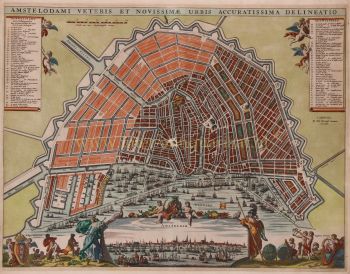
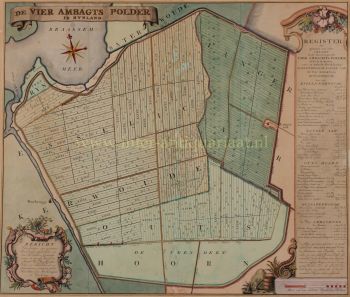
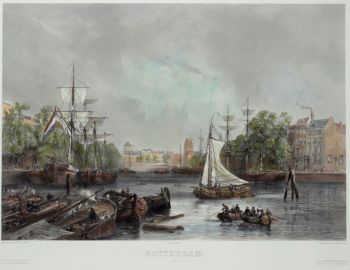
Antique map of Amsterdam, Amstel canal - Daniël Stoopendael + Widow Nicolaes Visscher, ca. 1720 by Artista Desconhecido
Scroll to zoom, click for slideshow

Antique map of Amsterdam, Amstel canal - Daniël Stoopendael + Widow Nicolaes Visscher, ca. 1720 1720

Artista Desconhecido

Imprimir
57 ⨯ 94 cm
€ 4.250

Inter-Antiquariaat Mefferdt & De Jonge
  • Sobre arte
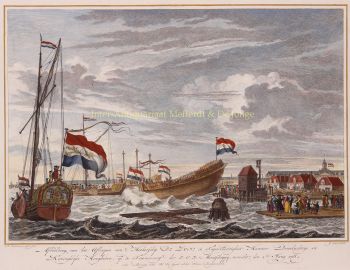
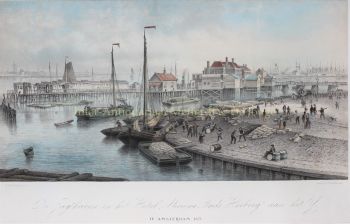
    BUSY 18TH CENTURY AMSTERDAM CANAL "Gezicht op de Binnen Amstel en Schut Sluys, ‘t Diaken Weeshuys nabij de Blauwe Brug vanaf de Amstelbrug gezien." [View of the inner Amstel river and lock, the orphanage near the Blauwbrug, seen from the Amstel Bridge." Etching with engraving printed from 2 copper plates, made by Daniël Stoopendael (1672-1726), published in Amsterdam by the Widow of Nicolaas Visscher around 1720. Coloured by a later hand. Size (plate):  approx. 57,8 x 94 cm. After the enlargement of the so called 'Grachtengordel' [today's canal district] with a fourth extention, a bridge was built over the Amstel in 1662, connecting the city walls on both sides of the river. The bridge had the same height as the ramparts, approx. six meters, and was therefore soon called 'Hogesluis' [high lock]. Here we see the Amstel river from this Hogesluis in a northerly direction to the Amstelsluizen, the Magere Brug (built in 1691) and the Blauwbrug. The Amstel locks were constructed to improve the water renewal of the tidal river Amstel and the so called 'Burgwallen'. This was to prevent the strongly increased pollution of the Amstel and the canals. Initially there were to be two locks, later this was changed to three: a large one in the middle and a smaller one on either side. At that time there was a sluice gate between the outer locks and the two Amstel quays. The wooden houses were used for the collection of municipal taxes. The brick house on the left was for the lock keeper. In the background, behind the Blauwbrug, we see the Diaconie Weeshuis (an orphanage), where the Stopera (town hall/opera building) is located today. On the right side of the Amstel (where there is a windmill), is the location of the Carré theater since 1887. This large print is from a series of 25 separately published cityscapes and provides a magnificent picture of life in Amsterdam at the beginning of the 18th century. Reference: Hollstein 11; auction R.W.P. de Vries 1925, lot no. 275; auction Leonhardt collection, Christie's 1989, lot no. 29. Price: Euro 4.250,-
  • Sobre artista

    Pode acontecer que um artista ou criador seja desconhecido.

    Algumas obras não devem ser determinadas por quem são feitas ou são feitas por (um grupo de) artesãos. Exemplos são estátuas dos tempos antigos, móveis, espelhos ou assinaturas que não são claras ou legíveis, mas também algumas obras não são assinadas.

    Além disso, você pode encontrar a seguinte descrição:

    •"Atribuído a …." Na opinião deles, provavelmente uma obra do artista, pelo menos em parte

    • “Estúdio de…” ou “Oficina de” Em sua opinião um trabalho executado no estúdio ou oficina do artista, possivelmente sob sua supervisão

    • "Círculo de ..." Na opinião deles, uma obra da época do artista mostrando sua influência, intimamente associada ao artista, mas não necessariamente seu aluno

    •“Estilo de…” ou “Seguidor de…” Na opinião deles, um trabalho executado no estilo do artista, mas não necessariamente por um aluno; pode ser contemporâneo ou quase contemporâneo

    • "Maneira de ..." Na opinião deles, uma obra no estilo do artista, mas de data posterior

    •"Depois …." Na opinião deles uma cópia (de qualquer data) de uma obra do artista

    • “Assinado…”, “Datado…” ou “Inscrito” Na opinião deles, a obra foi assinada/datada/inscrita pelo artista. A adição de um ponto de interrogação indica um elemento de dúvida

    • "Com assinatura ….”, “Com data ….”, “Com inscrição ….” ou “Tem assinatura/data/inscrição” na opinião deles a assinatura/data/inscrição foi adicionada por outra pessoa que não o artista

Você está interessado em comprar esta obra de arte?