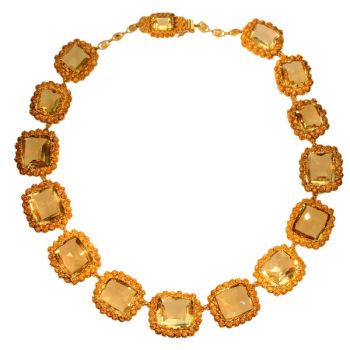
Historic 1820 Citrine and Gold Necklace, Filigree and Granulation, Very Fine Condition 1820
Artista Desconhecido
CitrineFiligranaOuroGemstone
€ 18.500
Adin Fine Antique Jewellery
- Sobre arte
A radiant necklace from the Southern Netherlands, circa 1820, crafted in 18K yellow gold with fine filigree and granulation work. The design showcases fourteen oval citrines, their honeyed glow framed by delicate scrolls of gold wire. Both Georgian andearly Victorian in spirit, this jewel reflects the transition of taste between eras, blending opulence with refined lace-like artistry. The cornucopia hallmark affirms its regional origin, while its generous proportions and luminous stones evoke theelegance of early 19th-century fashion. A jewel of distinction, still in very good condition, offering a timeless glimpse of its age.
Jewellery Type
necklace
Condition
very good condition
more info on our condition scale
Country of origin
"The Southern Netherlands" refers to the historical term used for the southern region that encompasses present-day Belgium and the southern part of the Netherlands. (Belgium gained independence from the Netherlands in 1831.)
Style
Pre-Victorian -
See also: Pre-Victorian
more info on styles
Period
ca. 1820
Events & facts of this era, poetry of this era, fashion of this era.
Material 18K
yellow gold (touchstone tested)
more info on precious metals
Technique
Granulation is a technique where the goldsmith uses very small balls (granules) of metal, which are not soldered to the piece but welded. This technique demand very high skills and precision from the maker. And filigree (formerly written filigrann orfiligrane) which is a delicate kind of jewel work made with twisted threads usually of gold and silver or stitching of the same curving motifs. It often suggests lace and French from 1660 to the late 19th century. It should not be confused with ajourejewellery work; while both have many open areas, filigree involves threads being soldered together to form an object and ajoure involves holes being punched, drilled, or cut through an existing piece of metal. (from:Wikipedia)
Precious stones
Fourteenoval citrine stones
It is a very common practice to treat gemstones to intensify their clarity or colour. The item in question has not been tested in this regard.
Birthstones
Citrine is the birthstone (or month stone) for November.
more info on birthstones
Hallmarks
The hallmark found (the cornucopia or horn of plenty) in this jewel was used in the former Southern Netherlands (now Belgium) between 1815 and 1832.
more info on hallmarks
Dimensions
length 42,50 cm (16,73 inch) height center piece 3,28 cm (1,29 inch)
see picture with a ruler in millimeters and inches
Weight
50,10 gram (32,21 dwt)
Adin Reference Nº
25125-0132
Copyright photography
Adin, fine antique jewellery
Additional information
our latest acquisitions
jewelry glossary
wall of fame
visit us in Antwerp
subscribe to our mailinglist
- Sobre artista
Pode acontecer que um artista ou criador seja desconhecido.
Algumas obras não devem ser determinadas por quem são feitas ou são feitas por (um grupo de) artesãos. Exemplos são estátuas dos tempos antigos, móveis, espelhos ou assinaturas que não são claras ou legíveis, mas também algumas obras não são assinadas.
Além disso, você pode encontrar a seguinte descrição:
•"Atribuído a …." Na opinião deles, provavelmente uma obra do artista, pelo menos em parte
• “Estúdio de…” ou “Oficina de” Em sua opinião um trabalho executado no estúdio ou oficina do artista, possivelmente sob sua supervisão
• "Círculo de ..." Na opinião deles, uma obra da época do artista mostrando sua influência, intimamente associada ao artista, mas não necessariamente seu aluno
•“Estilo de…” ou “Seguidor de…” Na opinião deles, um trabalho executado no estilo do artista, mas não necessariamente por um aluno; pode ser contemporâneo ou quase contemporâneo
• "Maneira de ..." Na opinião deles, uma obra no estilo do artista, mas de data posterior
•"Depois …." Na opinião deles uma cópia (de qualquer data) de uma obra do artista
• “Assinado…”, “Datado…” ou “Inscrito” Na opinião deles, a obra foi assinada/datada/inscrita pelo artista. A adição de um ponto de interrogação indica um elemento de dúvida
• "Com assinatura ….”, “Com data ….”, “Com inscrição ….” ou “Tem assinatura/data/inscrição” na opinião deles a assinatura/data/inscrição foi adicionada por outra pessoa que não o artista

Você está interessado em comprar esta obra de arte?
Artwork details
Related artworks
- 1 - 4 / 12
- 1 - 4 / 24
- 1 - 4 / 24
Artista Desconhecido
Anel eduardiano com mudança de cor de safira1910 - 1920
Preço em pedidoAns Hemke-Kuilboer Juwelier & Antiquair
1 - 4 / 24Artista Desconhecido
Pulseira de diamante do século 18 com entalhes de 2.000 anos1790
€ 23.000Adin Fine Antique Jewellery
Com curadoria deDanny Bree
1 - 4 / 12