Uma cabeça de terracota romano-egípcia de Alexandre o Grande, - 1796
William Alexander
€ 195
Inter-Antiquariaat Mefferdt & De Jonge
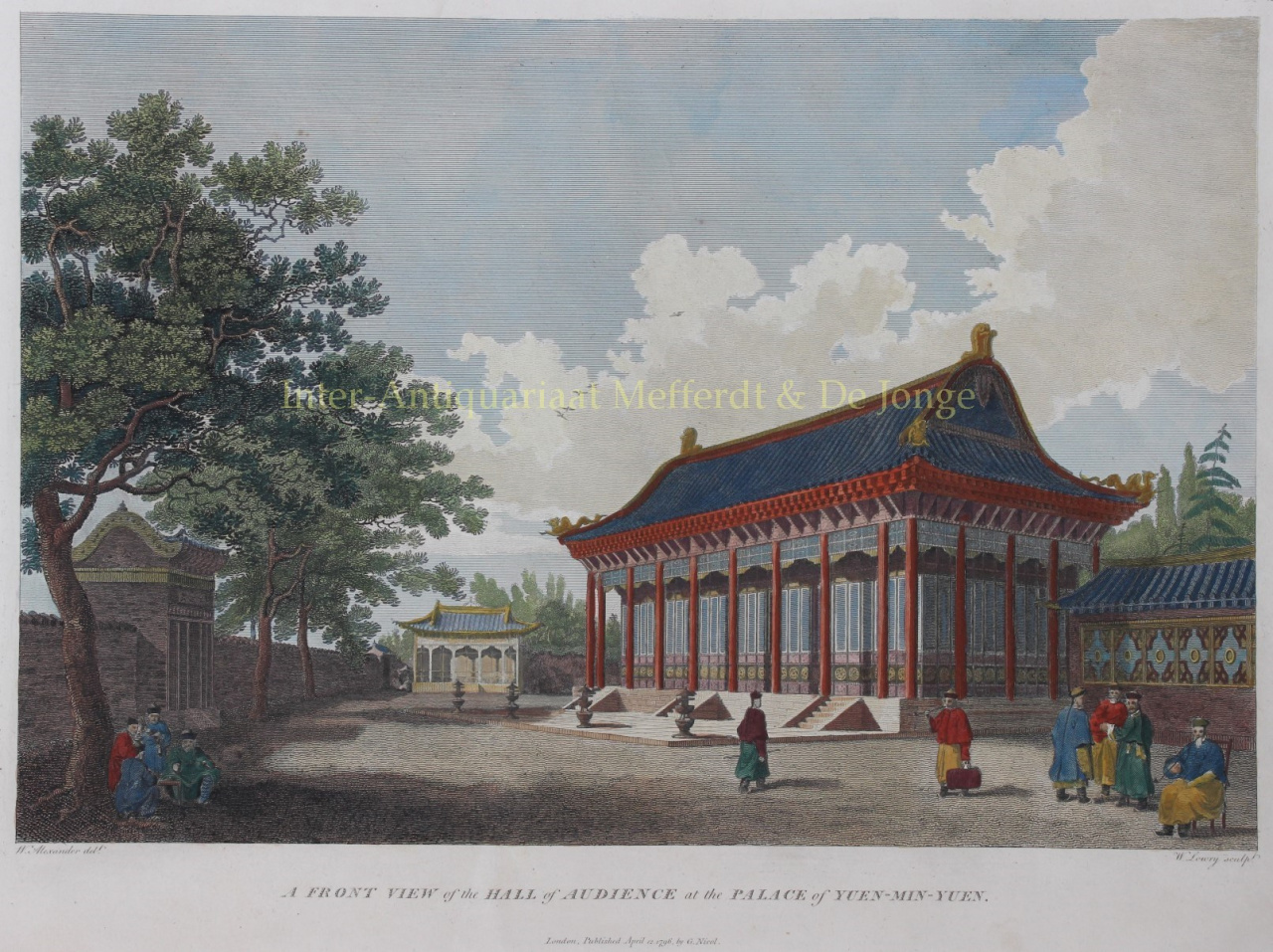
- Sobre arte“A Front View of the Hall of Audience at the Palace of Yuen-Min-Yuen” Copper engraving by Wilson Lowry after a drawing by William Alexander (1767-1816 ) from the “Authentic account of an embassy from the King of Great Britain to the Emperor of China; including cursory observations made, and information obtained, in travelling through that ancient empire” written by Sir George Leonard Staunton and published April 12, 1796 in London by G. Nicol. Coloured by a later hand. Size (image): 23,9 x 35,8 cm. The embassy was headed by Earl George Macartney (1737-1806), who was dispatched to Beijing in 1792. He was accompanied by Staunton a medical doctor as his secretary, and a retinue of suitably impressive size, including Staunton’s 11-year-old son who was nominally the ambassador’s page. On the embassy’s arrival in China it emerged that the 11-year-old was the only European member of the embassy able to speak Mandarin, and thus the only one able to converse with the Emperor. Lord Macartney's embassy was unsuccessful, the Chinese resisting British overtures to establish diplomatic relations in view of opening the vast Chinese realms to free trade, but it opened the way for future British missions, which would eventually lead to the first Opium War and the cession of Hong Kong to Britain in 1842. It also resulted in this invaluable account, prepared at government expense, largely from Lord Macartney's notes, by Staunton, of Chinese manners, customs and artifacts at the height of the Qing dynasty. The engravings are of special interest because of their depiction of subjects that very few Europeans had heard of or seen, showing how advanced Chinese civilisation was on a technical, artistic and organizational level. Staunton describes the the hall of audience as follows: "The outside of this hall had a magnificent appearance. The approach to it was thro three quadrangular courts, surrounded by buildings, separated from each other. It was erected upon a platform of granite, raised about four feet above the level of the court before it. Its projecting roof was supported upon two rows of large wooden columns, the shafts of which were painted red, and varnished; and the capitals ornamented with various scrolls and devices, in vivid colouring, particularly with dragons, whose feet were armed with five claws each. Dragons may be marked on the edifices and furniture of the princes of the Emperor's court, but with four claws only to their feet; the fifth is reserved for his Imperial Majesty alone. A net of gilt wire, scarcely perceptible, is spread over the whole entablature of the building, to prevent birds from resting upon any of the projecting points, of which a great number are brought out in a regular order." Price: Euro 195,-
- Sobre artista
William Alexander (1767–1816) foi o único artista inglês do final do século XVIII a entrar no interior da China, uma viagem que definiria a sua carreira e consolidaria a sua reputação. Nascido em Maidstone, Kent, filho de um fabricante de carruagens, demonstrou precoce talento artístico e estudou em Londres, possivelmente com Julius Caesar Ibbetson, antes de ingressar nas Royal Academy Schools.
Em 1792, Alexander juntou-se à embaixada britânica de Lord Macartney na China como desenhador júnior. Embora a missão diplomática não tenha conseguido estabelecer relações comerciais duradouras com o Imperador Qianlong, proporcionou a Alexander um extraordinário material de primeira mão. Numa época em que a Chinoiserie cativava a Europa, as suas detalhadas aguarelas de paisagens, arquitetura e vida quotidiana chinesas atraíram grande aclamação. Muitas foram gravadas para o relato oficial da embaixada e para publicações como *View of the Headlands, Islands, etc.* (1798) e *A Voyage to Cochin China* (1806), de John Barrow.
De regresso a Inglaterra, Alexander aprimorou os seus esboços chineses, transformando-os em peças de exposição para a Royal Academy, e trabalhou no vibrante círculo de aguarela em torno do Dr. Monro, ao lado de artistas como Thomas Girtin. Em 1802, tornou-se professor de desenho de paisagem na Real Academia Militar de Great Marlow.
Em 1808, demitiu-se deste cargo para se tornar um dos primeiros curadores do Museu Britânico, desempenhando as funções de curador de gravuras e desenhos e bibliotecário assistente. Aí, começou a compilar o primeiro inventário de gravuras e desenhos do museu e ilustrou importantes antiguidades da coleção Townley. Membro da Sociedade de Antiquários, Alexander dedicou-se cada vez mais a paisagens pitorescas e a estudos de objetos clássicos.
Faleceu em 1816 em Maidstone, aos quarenta e nove anos. Hoje, a sua obra integra importantes coleções públicas, incluindo a British Library, a Tate e o Victoria and Albert Museum, e permanece um inestimável registo visual da China do final do século XVIII na perspetiva britânica.

Você está interessado em comprar esta obra de arte?
Artwork details
Related artworks
- 1 - 4 / 12
- 1 - 4 / 24
- 1 - 4 / 12