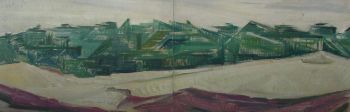
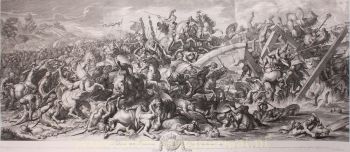
Victory of the Veronese over the Gardesans - Gaetano Zancon after Bruzasorzi, end 18th century by Artista Desconhecido
Scroll to zoom, click for slideshow

Victory of the Veronese over the Gardesans - Gaetano Zancon after Bruzasorzi, end 18th century late 18th

Artista Desconhecido

PapelLápis de cor
29 ⨯ 65 cm
€ 1.250

Inter-Antiquariaat Mefferdt & De Jonge

  • Sobre arte
    VICTORY OF THE VERONESE OVER THE GARDESANS – ANTEDATING VERONA’S AUTONOMY “Battaglia e Vittoria Riportata tra Sermione e Rivoltella alla Villa Arriga da Veronesi l’anno 849 sopra que della Rivera di Salo“ (Battle and victory achieved between Sirmione and Rivoltella at Villa Arriga by the Veronese in the year 849 along the shores of Lake Garda near the Salò area). Drawing in sepia and engraving, both made at the end of the 18th century by Gaetano Zancon after a painting by Felice Riccio (Brusasorzi) (1542-1605). Size (each): 29,3 x 65,3 cm. The depicted scene marks the first triumph of the city of Verona. Two coats of arms spot the Veronese troops: the Palazzo di Teodorico on the left standard and the Veronese flag in the center which is being waved as a sign of victory over the rebelling Gardesans. Brusasorzi’s (very large) painting was commissioned in 1595 to celebrate the illustrious deeds and fortunate events of the city and now (since 1950) hangs in Palazzo Barbieri, the town hall of Verona. The historical context to which the scene refers, a mere invention, is that of the autonomy of the Garda judiciary in the Carolingian era. According to the story that emerged in late-sixteenth-century Verona, in the mid-ninth century, a revolt of the Garda populations, previously subject to Verona, would have occurred. Veronese forces would have suppressed the revolt, and during this war, they supposedly adopted the new city emblem, a yellow cross on a blue field (waved in the centre of the scene), replacing the red cross on a white field. In fact, the replacement of the emblems dates back to 1259-60. The first manifestation of the autonomy and awareness of the city commune is thus antedated four centuries earlier. The specific objective is evidently to emphasize the original subjection of the Garda territory to the city, challenging the autonomy and privileges that the communities of that territory (especially those along the shore, constituting the so-called “Gardesana dell’Acqua”) had consistently claimed during the Venetian era in which the painting was made. The fact that Geatano Zancon (1771-1816) copied the painting two hundred years later, suggests that the triumph of Verona continued to be a remarkable event -whether fiction or not- that should make every Veronese proud. Here we have both the engraving as well as Zancon’s original drawing after the painting (which he needed to make the engraving). Price: Euro 1.250,- (for both the drawing and the engraving)
  • Sobre artista

    Pode acontecer que um artista ou criador seja desconhecido.

    Algumas obras não devem ser determinadas por quem são feitas ou são feitas por (um grupo de) artesãos. Exemplos são estátuas dos tempos antigos, móveis, espelhos ou assinaturas que não são claras ou legíveis, mas também algumas obras não são assinadas.

    Além disso, você pode encontrar a seguinte descrição:

    •"Atribuído a …." Na opinião deles, provavelmente uma obra do artista, pelo menos em parte

    • “Estúdio de…” ou “Oficina de” Em sua opinião um trabalho executado no estúdio ou oficina do artista, possivelmente sob sua supervisão

    • "Círculo de ..." Na opinião deles, uma obra da época do artista mostrando sua influência, intimamente associada ao artista, mas não necessariamente seu aluno

    •“Estilo de…” ou “Seguidor de…” Na opinião deles, um trabalho executado no estilo do artista, mas não necessariamente por um aluno; pode ser contemporâneo ou quase contemporâneo

    • "Maneira de ..." Na opinião deles, uma obra no estilo do artista, mas de data posterior

    •"Depois …." Na opinião deles uma cópia (de qualquer data) de uma obra do artista

    • “Assinado…”, “Datado…” ou “Inscrito” Na opinião deles, a obra foi assinada/datada/inscrita pelo artista. A adição de um ponto de interrogação indica um elemento de dúvida

    • "Com assinatura ….”, “Com data ….”, “Com inscrição ….” ou “Tem assinatura/data/inscrição” na opinião deles a assinatura/data/inscrição foi adicionada por outra pessoa que não o artista

Você está interessado em comprar esta obra de arte?