VIEW OF 17TH CENTURY AMSTERDAM  by Caspar Merian
Scroll to zoom, click for slideshow

VIEW OF 17TH CENTURY AMSTERDAM  1650

Caspar Merian

PapelImprimir
19 ⨯ 70 cm
€ 1.250

Inter-Antiquariaat Mefferdt & De Jonge

  • Sobre arte
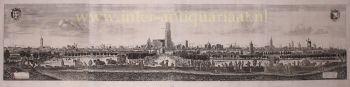
    VIEW OF 17TH CENTURY AMSTERDAM  "Amsterdam", engraving printed from two copperplates, made around 1650, published in Frankfurt am Main by Caspar Merian in 1659. Coloured by a later hand. Size: 19.5 × 70.5 cm. From the Topographia Germaniae Inferioris. From left to right one can distinguish the Rijzenhoofd, the Antoniespoort, the West India warehouse, the Montelsbaanstoren, Zuiderkerk tower, Munttoren, and Schreierstoren, the Walloon Church, Sint-Olofskapel,(Chapel of St. Olaf), the Old Church, the Nieuwezijds Kapel, the stock exchange, the Waag, the old Town Hall with its pointed tower, the Nieuwe Kerk with its completed tower, the Jan Rodenpoort tower, Haringpakkers tower, and Wester tower, the Noorderkerk, the Bickers tower, and the Haarlemmerpoort. The city’s grain warehouses are also depicted; the old Town Hall had not yet burned down (1652). Topographia Germaniae Inferioris was part of the Topographia Germaniae, the most important work of engraver and publisher Matthäus Merian the Elder (1593–1650). He published this monumental work together with Martin Zeiler (1589–1661) of Ulm, who was responsible for the text. The work contains around 2,000 illustrations and plans of towns, monasteries, and castles and is considered one of the most significant achievements in the field of topographical illustration. Merian had begun in 1642 with the publication of a survey of town views, landscapes, and maps, for which he had been collecting drawings for decades. Up to 1688 the series was expanded with further descriptions of European regions, ultimately reaching 30 volumes with a total of 92 maps and 2,142 town views, making it one of the largest publications of its time. The first volumes were engraved and published by Matthäus Merian himself. Later, much of the engraving work was commissioned from several prominent engravers of the day, while his sons Matthäus the Younger and Caspar took over the publishing activities. Price: Euro 1.250,-
  • Sobre artista

    Caspar Merian (1627–1686) foi um proeminente gravador topográfico, cartógrafo e editor suíço-alemão, que desempenhou um papel fundamental na continuidade de uma das mais influentes dinastias editoriais do século XVII. Nascido na conceituada família Merian, era filho de Matthäus Merian, o Velho, cuja oficina em Frankfurt se tornara um importante centro de livros ilustrados e mapas na Europa.Caspar Merian (1627–1686) foi um proeminente gravador topográfico, cartógrafo e editor suíço-alemão, que desempenhou um papel fundamental na continuidade de uma das mais influentes dinastias editoriais do século XVII. Nascido na conceituada família Merian, era filho de Matthäus Merian, o Velho, cuja oficina em Frankfurt se tornara um importante centro de livros ilustrados e mapas na Europa.

    Juntamente com o seu irmão, Matthäus Merian, o Jovem, Caspar assumiu o controlo da editora da família em Frankfurt e expandiu ainda mais a sua reputação por obras topográficas e históricas de alta qualidade. As suas publicações combinavam uma precisão geográfica detalhada com uma narrativa visual rica, contribuindo significativamente para a disseminação do conhecimento sobre as regiões e cidades europeias.

    Entre as suas obras mais importantes contam-se os volumes da série Topographia, incluindo Topographia Germaniae Inferioris vel Circuli Burgundici, que forneciam descrições detalhadas e gravuras das principais cidades e regiões das Dezassete Províncias (os Países Baixos). Contribuíram também para a continuidade do monumental Theatrum Europaeum, uma extensa crónica dos acontecimentos políticos e militares europeus.

    Mais tarde, devido a problemas de saúde, Caspar Merian mudou-se de Frankfurt para Wertheim em 1672 e, posteriormente, para a Frísia em 1677, onde se juntou à comunidade religiosa labadista. Apesar destas alterações posteriores, a sua obra manteve-se profundamente influente. Através das suas gravuras e publicações, Caspar Merian ajudou a moldar a cartografia e a representação topográfica da Europa moderna, preservando e ampliando o legado da editora Merian.

Você está interessado em comprar esta obra de arte?

Artwork details