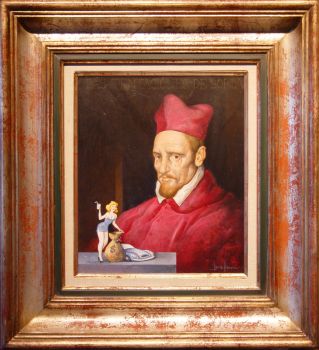
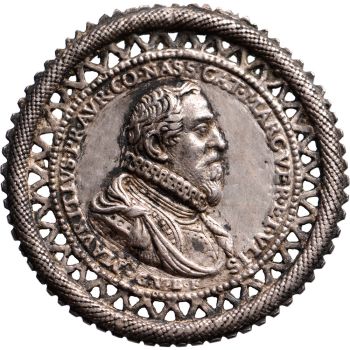
Portrait of a man with two Gnadenpfennigs, likely Wilhelm Daser (1566-1639) by Artista Sconosciuto

Portrait of a man with two Gnadenpfennigs, likely Wilhelm Daser (1566-1639) 1612

Artista Sconosciuto

LegnaPittura a olioMetalloRameDipingere
€ 2.500

Jongeling Numismatics & Ancient Art

  • A proposito di opere d'arte
    German school, unsigned but attributed to Lorenz Strauch, dated 1612.

    Oil on copper, ca. 10.5 x 13.0 cm. Including frame: 17.0 x 19.5 cm

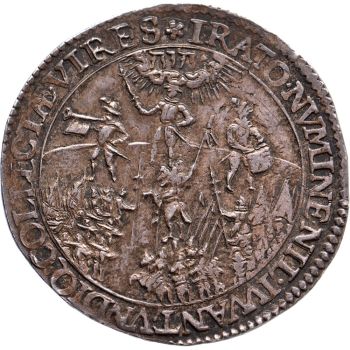
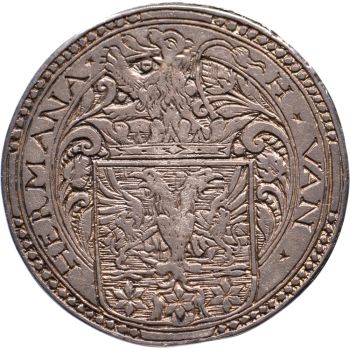
    Portrait three-quarter facing, dressed in black with millstone collar. Around the neck and also around the waist a gnadenpfennig with portrait, probably of the Duke of Wurtemberg. Coat of arms with typical German beak-shaped crest and dating top right.
    Good condition, some retouching and locally blurred in varnish. In probably 19th century plaster frame.

    Lorenz Strauch (1554-1630) was a Nuremberg painter and copper engraver who focused mainly on portraiture. Many of his portraits are signed with his full name or his monogram LS. A few however, are unsigned, and are attributed to him on the basis of style. Characteristic of Strauch is the suspicious look of the painted.
  • A proposito di opere artista

    Può succedere che un artista o un creatore sia sconosciuto.

    Alcune opere non sono determinate da chi sono state realizzate o sono state realizzate da (un gruppo di) artigiani. Esempi sono statue dell'antichità, mobili, specchi o firme non chiare o leggibili ma anche alcune opere non sono affatto firmate.

    Inoltre puoi trovare la seguente descrizione:

    •"Attribuito a …." A loro avviso probabilmente opera dell'artista, almeno in parte

    •“Studio di ….” o “Officina di” A loro avviso un'opera eseguita nello studio o nella bottega dell'artista, eventualmente sotto la sua supervisione

    •“Cerchio di…” A loro avviso un'opera del periodo dell'artista che mostra la sua influenza, strettamente legata all'artista ma non necessariamente al suo allievo

    •"Stile di..." o "Seguace di..." A loro avviso un'opera eseguita nello stile dell'artista ma non necessariamente da un allievo; può essere contemporaneo o quasi contemporaneo

    •“Modalità di…” A loro avviso un'opera nello stile dell'artista ma di epoca successiva

    •"Dopo …." A loro avviso una copia (di qualsiasi data) di un'opera dell'artista

    •“Firmato…”, “Datato…” o “Iscritto” A loro avviso l'opera è stata firmata/datata/inscritta dall'artista. L'aggiunta di un punto interrogativo indica un elemento di dubbio

    •"Con firma....", "Con data...", "Con iscrizione..." o “Riporta firma/data/iscrizione” a loro avviso la firma/data/iscrizione è stata aggiunta da qualcuno diverso dall'artista

Sei interessato ad acquistare questa opera d'arte?

Artwork details