terra Santa 1595
Abraham Ortelius
€ 2.950
Inter-Antiquariaat Mefferdt & De Jonge
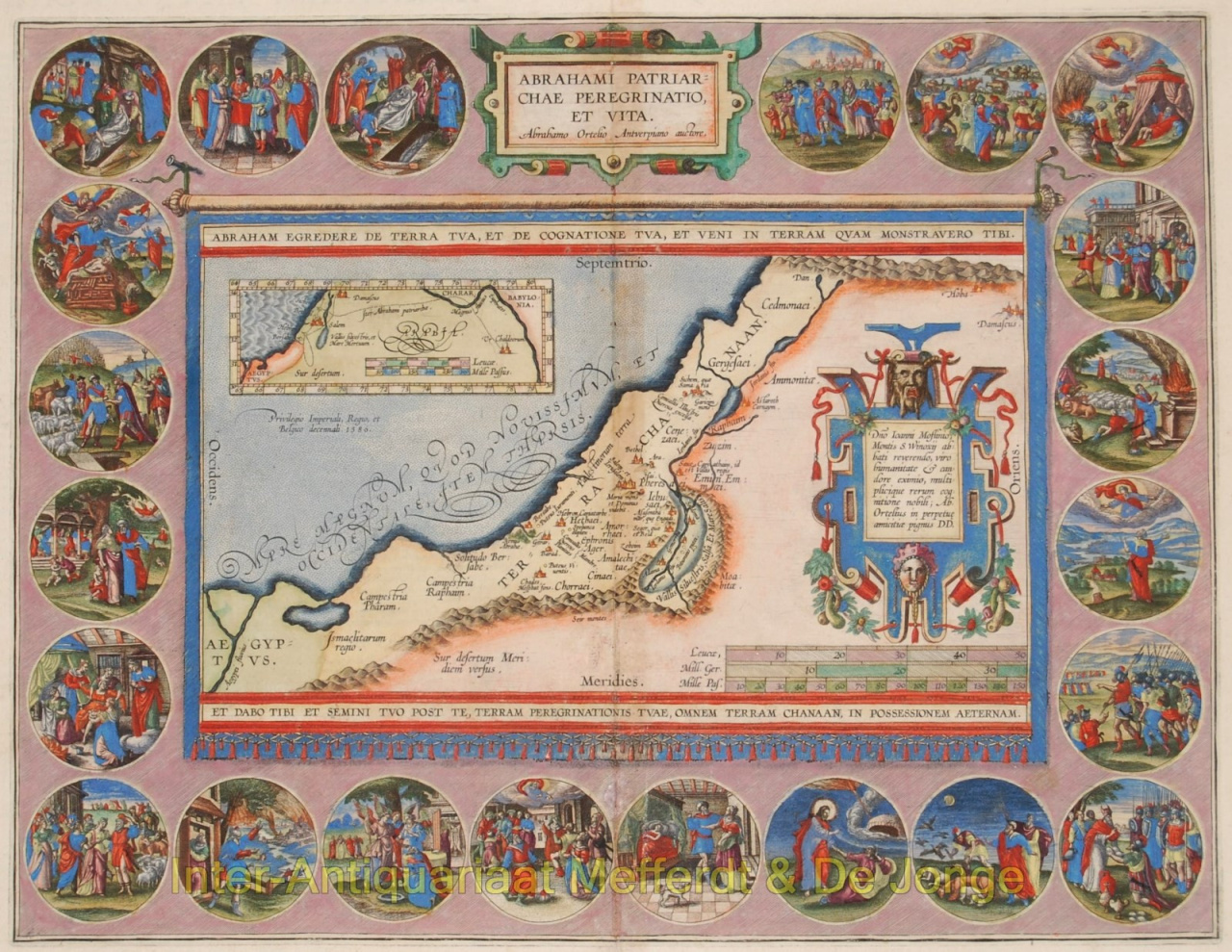
- A proposito di opere d'arteHOLY LAND WITH THE WANDERINGS OF ABRAHAM IN BEAUTIFUL ORIGINAL COLOUR "Abrahami Patriarchae peregrinatio, et vita". Copper engraving published by Abraham Ortelius as part of his Theatrum Orbis Terrarum, in the (rare) Latin edition of 1595. Beautiful original hand colouring. Size: 35,3 x 46,6 cm. During the sixteenth century in the Low Countries, while Gerard Mercator was the preeminent cartographical innovator and draftsman, his friend and rival Abraham Ortelius became the most important map and atlas publisher. Ortelius' atlas Theatrum Orbis Terrarum, revolutionised geographical publishing. As he expanded it in subsequent editions, he included a number of maps important to the history of mapping the Holy Land; one of which being this beautiful map surrounded by vignettes of the life of the Patriarch Abraham. The map became part of the expanding supplement of historical maps, entitled the Parergon, that Ortelius appended to his atlas of modern maps. Largely the work of the master himself, the maps in the Parergon, and this one in particular, are the best engravings that reflect the widespread sixteenth-century interest in classical geography. Territorial divisions on the map are taken from the story Abraham in Genesis. Ancient tribal names are preserved in the regions of the Philistines, Amelechites, Jebusites, Cenezites, and Gergesites. The cities of Sodom and Gomorrah still thrive along the southern Jordan in the "Valley of the Forest of Salt", which was to become the Dead Sea. An inset shows the stages of the wanderings of Abraham, from Ur of the Chaldees, the lower Euphrates Valley, to Shechem, Bethel, Damascus, Egypt, and Hebron. In keeping with the title and biblical theme of the engraving, twenty-two medallions depicting scenes from the life of Abraham leaving Ur, sacrificing on the newly built altars at Shechem and Bethel, receiving the promise of the land, the birth of Isaac, the expulsion of Hagar, the sacrifice of Isaac, and the burials of Sarah and Abraham. The Wanderings of Abraham is among the most elaborate of Ortelius' compositions. It demonstrates his combined skills as a cartographer and an artist, and his accomplishment as an historian. Ortelius imaginatively enlivened the earliest period of biblical history for the readers of his Parergon. Price: Euro 2.950,-
- A proposito di opere artista
Abraham Ortelius (1527–1598) fu un cartografo e geografo fiammingo, ampiamente considerato il creatore del primo atlante moderno e uno dei cartografi più influenti della storia. La sua rivoluzionaria pubblicazione, Theatrum Orbis Terrarum (Teatro del Mondo), segnò una svolta nel modo in cui la conoscenza geografica veniva raccolta, standardizzata e presentata.
Pubblicato per la prima volta nel 1570, Theatrum Orbis Terrarum fu rivoluzionario sia nel concetto che nell'esecuzione. A differenza delle precedenti raccolte di mappe, l'atlante di Ortelius offriva una panoramica coerente e sistematica del mondo conosciuto, con mappe di dimensioni, stile e qualità uniformi, accompagnate da commenti accademici. Questo approccio trasformò la cartografia da un'arte frammentata a una disciplina scientifica e culturale strutturata, rendendo la geografia globale accessibile a studiosi, mercanti e statisti.
Ortelius visse e lavorò durante l'età d'oro della cartografia olandese, un periodo in cui i progressi nell'esplorazione, nella stampa e nel commercio rimodellarono la comprensione del mondo da parte dell'Europa. Insieme a Gerardo Mercatore, Ortelio è considerato uno dei padri fondatori della scuola cartografica olandese. Mentre Mercatore rivoluzionò la proiezione cartografica, Ortelio eccelleva nella sintesi, riunendo le migliori conoscenze geografiche disponibili in un'unica opera autorevole.
Oltre ai suoi successi tecnici, Ortelio fu un pensatore umanista con un profondo interesse per la storia, l'antichità classica e gli scambi culturali. Mantenne una vasta rete internazionale di studiosi, esploratori e cartografi, attribuendo scrupolosamente la paternità alle fonti, una pratica insolita e progressista per la sua epoca. Questa integrità accademica contribuì in modo significativo alla credibilità e all'influenza duratura della sua opera.
L'eredità di Abraham Ortelio non risiede solo nelle sue mappe, ma nella sua visione del mondo come un tutto interconnesso. Il suo atlante ha plasmato la visione del mondo europea per generazioni e ha gettato le basi per la cartografia moderna, assicurandogli un posto tra le grandi figure intellettuali del Rinascimento.

Sei interessato ad acquistare questa opera d'arte?
Artwork details
Related artworks
- 1 - 4 / 6
- 1 - 4 / 24
- 1 - 4 / 12