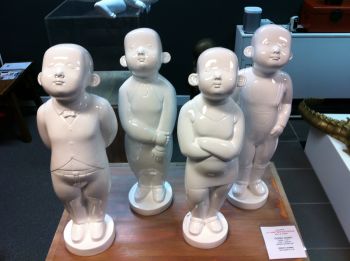
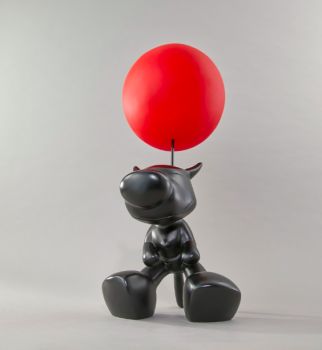
'Tiananmen Square' by Zhang Hui
Scroll to zoom, click for slideshow

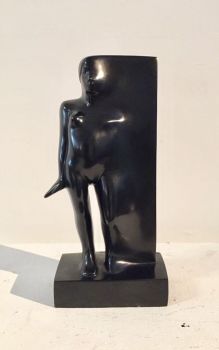
'Tiananmen Square' 2006

Zhang Hui

VerreFibre de verre
100 ⨯ 109 ⨯ 41 cm
ConditionVery good
€ 8.000

Willem Kerseboom Gallery

  • Sur l'oeuvre d'art
    WILLEM KERSEBOOM MODERN & CONTEMPORARY ART

    Zhang Hui (born in 1969)
    Beijing Wawa Tian'An Men Square,gold, 2007-2008 Fiberglass Signed, dated, titled and numbered on the base: "1/3" Edition of 3 100 x 109 x 41 cm

    Zhang Hui has been included in exhibitions throughout China and Europe and has established herself as an important figure in the contemporary Chinese art world. Born in Yinchuan province in 1969, Zhang Hui graduated from the prestigious Sichuan Academy of Fine Arts and now lives and works in Beijing. Zhang Hui has developed and refined her style over many years. Zhang Hui utilized the skills she had learned from her study of calligraphy and traditional arts and applied them to her own concepts, gradually finding her own direction. Zhang Hui began to study diverse representations of women in sources such as the Chinese cinema of the thirties, propaganda imagery from the Cultural Revolution, advertisements, models and fashion magazines. She was searching for a way to express the modern day Beijing woman based on her own personal experiences and the issues facing contemporary Chinese women. She has created a character to express this: “Beijing Wawa” meaning “Beijing Baby.” “Beijing Wawa” signifies clichéd young girls searching for identity within a society driven by the commodification of culture. The subject of childhoods lost under Mao is a common one in China, but Zhang Hui is looking at her own generation and at a new loss of innocence stolen by new ideals and vacant dreams. “Beijing Wawa” has particular characteristics that exaggerate her personality such as a heart-shaped upper lip, a peach-shaped baby face, a tiny nose that is slightly upturned, and hair like an angel’s wings. She also often has scar on her forehead, like Zhang Hui herself. “Beijing Wawa” reflects a complex, emotional landscape within the portraits of young girls, there is a presence of power balanced with vulnerability, beauty with scars, and youth with maturity.


  • Sur l'artiste

    Zhang Hui (née en 1969) est une artiste contemporaine chinoise connue pour ses représentations saisissantes de femmes, tirées du langage visuel en évolution des médias chinois. Diplômée de la prestigieuse Académie des Beaux-Arts du Sichuan, elle réside actuellement à Pékin, où elle continue d'explorer les intersections de l'histoire, de la culture et de la commercialisation dans son travail.

    Son art est profondément ancré dans la représentation des femmes chinoises à travers différentes époques, s'inspirant du cinéma des années 1930, des images de propagande de la Révolution culturelle et de la photographie de mode moderne. À travers ces influences, Zhang construit un dialogue visuel sur la féminité, l'identité et la transformation sociétale en Chine. L'une de ses contributions les plus distinctives est la création de « Beijing Wawa » (« Bébé de Pékin »), un personnage stylisé incarnant les contradictions de la féminité contemporaine en Chine.

    Avec des traits exagérés – un visage en forme de pomme, une lèvre supérieure en forme de cœur et un nez en pointe – Beijing Wawa sert à la fois de critique et de célébration de l'image féminine idéalisée dans la Chine moderne. Zhang Hui a notamment donné à ce personnage une cicatrice au front, à l’image de la sienne, ajoutant ainsi une dimension narrative personnelle à son travail.

    L’art de Zhang Hui a été exposé à l’échelle internationale, notamment à New York, Bologne et Hambourg, consolidant sa position de voix importante dans l’art contemporain chinois. Grâce à son langage visuel distinctif, elle remet en question les perceptions traditionnelles et modernes des femmes, offrant une exploration stimulante de la beauté, de l’influence des médias et de l’évolution des rôles des femmes dans la société chinoise.

Êtes-vous intéressé par l'achat de cette oeuvre?

Artwork details