A pair of Dutch Colonial Solid Satinwood Chairs, Ceylon 18th century by Onbekende Kunstenaar

A pair of Dutch Colonial Solid Satinwood Chairs, Ceylon 18th century 1725 - 1750

Onbekende Kunstenaar

101 ⨯ 75 ⨯ 50 cm
ConditionGood
Prijs op aanvraag

Menken Works of Art

  • Over kunstwerk
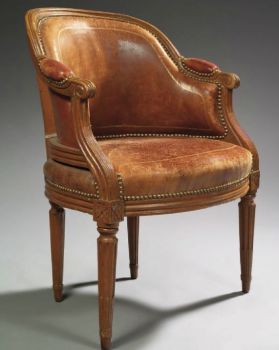
    A pair of Dutch colonial solid satinwood chairs.
    Galle, Ceylon (Sri Lanka), c. 1725-1750.

    The chairs are richly carved, featuring a shell motif at the crest of the backrest, flanked by two birds with open lion-like mouths. Furthermore with floral and acanthus leaf carvings, shell motifs, and claw feet.

    Crafted from Ceylon Satinwood (Chloroxylon swietenia), these chairs were most likely made by Sinhalese artisans in the Black Town (Pettah) district of Colombo during the VOC (Dutch East India Company) period in Dutch Ceylon (1664–1795).

    Such satinwood furniture, reflecting Dutch stylistic preferences, was favored by both Europeans and affluent Sinhalese families. While the overall form and decorative elements are inspired by 18th-century European models, the incorporation of carved birds—identified by R.L. Brohier as Garuda, the eagle mount of Vishnu—and the detailed carving reflect distinctive Sinhalese craftsmanship.

    Dimensions:
    Height 101 cm, width 75 cm, depth 50 cm, seat height 44 cm.

    Condition report and more pictures available upon request.

    Ref:
    An identical chair can be found in the Asian Civilisations Museum, Singapore (accession number 2015-00480).

    Also compare with a pair of chairs of the same design but with a different stretcher underneath the seating in the Cleveland Museum of Art (accession number 1922.677).

    Another similar chair, but with red and gold lacquer-work is in the Museum Sejarah Jakarta and illustrated in Furniture From Indonesia, Sri Lanka and India (Jan Veenendaal, 1985), p. 100, pl. 108.

    Other identical examples can be found in the Wolvendaal (Dutch Reformed) Church in Colombo, Sri Lanka and illustrated in situ in Furniture of the Dutch Period in Ceylon (R.L. Brohier, 1969), p. 14, fig. 14 and pl. X|||, fig. 4.

    Furthermore an identical chair is illustrated in Asian Art and the Dutch Taste (Jan Veenendaal, 2014), p. 63, pl. 92.

    Inv. No: MW270
  • Over kunstenaar

    Het kan voorkomen dat een kunstenaar of maker onbekend is.

    Voor sommige werken is het niet te bepalen door wie het gemaakt is of dat het is gemaakt door (een groep) ambachtslieden. Voorbeelden zijn beelden uit de Oudheid, meubels, spiegels of handtekeningen die vaak niet duidelijk of leesbaar zijn. Maar ook sommige werken zijn helemaal niet gesigneerd.

    Ook kunt u de volgende beschrijving vinden:

    •"Toegeschreven aan …." waarschijnlijk een werk van de kunstenaar maar niet zeker of gedeeltelijk

    •“Atelier van ….” of werkplaats van” een werk uitgevoerd in het atelier of atelier van de kunstenaar, eventueel onder zijn toezicht

    •“Cirkel van ….” een werk uit de periode van de kunstenaar die zijn invloed laat zien, nauw verbonden met de kunstenaar maar niet noodzakelijkerwijs zijn leerling

    •“Stijl van ….” of  “Volger van ….” een werk uitgevoerd in de stijl van de kunstenaar, maar niet noodzakelijk door een leerling; kan eigentijds of bijna eigentijds zijn

    •“Wijze van ….” een werk in de stijl van de kunstenaar maar van latere datum

    •"Na …." een kopie (van welke datum dan ook) van een werk van de kunstenaar

    •“Getekend…”,  “Gedateerd….”  of  “Ingeschreven” dan is het werk gesigneerd/ gedateerd/ ingeschreven door de kunstenaar. De toevoeging van een vraagteken duidt op een element van twijfel

    •"Met handtekening ...", "Met datum ...", "Met opschrift..." of “Draagt signatuur/datum/opschrift” dan is de handtekening/datum/opschrift toegevoegd door iemand anders dan de kunstenaar

Bent u geïnteresseerd om dit kunstwerk te kopen?