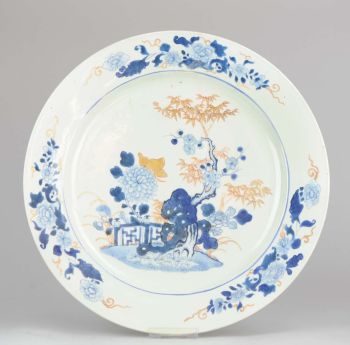
A pair of inscribed blue and white ‘Wild Goose Pagoda’ dishes for the Japanese market, Ko-Sometsuke, 1621 - 1672
Onbekende Kunstenaar
PorseleinChinees porselein
ø 21 cm
ConditionGood
Prijs op aanvraag
Menken Works of Art
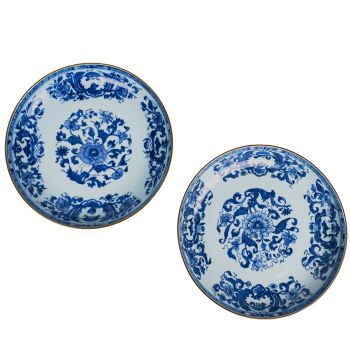
- Over kunstwerkA pair of inscribed blue and white ‘Wild Goose Pagoda’ dishes for the Japanese market, Ko-Sometsuke.
Ming dynasty, Tianqi Period (1621–1627).
The central scene depicts three geese standing in the foreground, with a fourth goose flying above them. Next to this scene appears a four-character inscription that can be translated as: “May your name be inscribed on the wall of the Wild Goose Pagoda in Chang’an.” In the distance, a promontory is shown with a pagoda and a nearby building.
Below this scene, painted upside down, is another four-line verse. This composition gives the impression of a reflection of the pagoda above. The text can loosely be translated as: “May you enjoy the Imperial Spring Banquet in the Apricot Grove.” Beside the inscription is a flowering apricot plant, with three swallows flying above it. The indented cavetto is decorated with a scrolling lotus motif set against a blue ground, while the outer border features a Greek key pattern on a pale blue background.
The first inscription, “May Your Name Be Inscribed on the Wall of the Wild Goose Pagoda in Chang’an,” refers to a tradition that began during the Tang dynasty (618–907). Candidates who successfully passed the highest level of the Jinshi civil service examinations were honored by having their names recorded on the wall of the Wild Goose Pagoda in Chang’an, the capital of the Tang empire.
The second inscription, “May You Enjoy the Imperial Spring Banquet in the Apricot Grove,” alludes to a celebratory banquet traditionally held near the Wild Goose Pagoda for those who had achieved success in the examinations. This message is further emphasized through a visual rebus that combines images of spring swallows with blooming apricot branches, both symbols associated with spring and scholarly achievement.
Diameter 21 cm.
Provenance:
Fa. A.C. Beeling & Zn., Leeuwarden, The Netherlands (sticker on one of the dishes)
Leegstra collection, Warffum, The Netherlands (sticker on both dishes)
Ref:
A similar dish is illustrated in Leaping the Dragon Gate: The Sir Michael Butler Collection of 17th-Century Chinese Porcelain (Katharine Butler, Teresa Canepa, 2021
Also see Four Centuries of Blue and White – The Frelinghuysen Collection of Chinese and Japanese Export Porcelain (Becky Macguire, 2023), p. 304, no. 248.
Another dish is in the Groninger Museum collection, object number 2018.0013.
Worldwide registered and insured shipping.
Inv. No: MW381 - Over kunstenaar
Het kan voorkomen dat een kunstenaar of maker onbekend is.
Voor sommige werken is het niet te bepalen door wie het gemaakt is of dat het is gemaakt door (een groep) ambachtslieden. Voorbeelden zijn beelden uit de Oudheid, meubels, spiegels of handtekeningen die vaak niet duidelijk of leesbaar zijn. Maar ook sommige werken zijn helemaal niet gesigneerd.
Ook kunt u de volgende beschrijving vinden:
•"Toegeschreven aan …." waarschijnlijk een werk van de kunstenaar maar niet zeker of gedeeltelijk
•“Atelier van ….” of werkplaats van” een werk uitgevoerd in het atelier of atelier van de kunstenaar, eventueel onder zijn toezicht
•“Cirkel van ….” een werk uit de periode van de kunstenaar die zijn invloed laat zien, nauw verbonden met de kunstenaar maar niet noodzakelijkerwijs zijn leerling
•“Stijl van ….” of “Volger van ….” een werk uitgevoerd in de stijl van de kunstenaar, maar niet noodzakelijk door een leerling; kan eigentijds of bijna eigentijds zijn
•“Wijze van ….” een werk in de stijl van de kunstenaar maar van latere datum
•"Na …." een kopie (van welke datum dan ook) van een werk van de kunstenaar
•“Getekend…”, “Gedateerd….” of “Ingeschreven” dan is het werk gesigneerd/ gedateerd/ ingeschreven door de kunstenaar. De toevoeging van een vraagteken duidt op een element van twijfel
•"Met handtekening ...", "Met datum ...", "Met opschrift..." of “Draagt signatuur/datum/opschrift” dan is de handtekening/datum/opschrift toegevoegd door iemand anders dan de kunstenaar
Bent u geïnteresseerd om dit kunstwerk te kopen?
Artwork details
Related artworks
Onbekende Kunstenaar
A white jade ‘Lotus Seedpod and Bug’ carving, Qing dynasty, 18th century18th century
Prijs op aanvraagMenken Works of Art
1 - 4 / 12Onbekende Kunstenaar
A rare Chinese blue and white bottle vase, Ming dynasty, Wanli period1573 - 1620
Prijs op aanvraagMenken Works of Art
1 - 4 / 6Onbekende Kunstenaar
Set Arita 'dog training' plates, 18th century 1700 - 1730
Prijs op aanvraagVerkoulen Oriental & European Antiques
Onbekende Kunstenaar
A Chinese famille verte ‘fishermen’ bowl, Kangxi period (1662-1722)1662 - 1722
Prijs op aanvraagMenken Works of Art
Onbekende Kunstenaar
A Chinese powder-blue-ground blue and white ‘Budai’ dish, Kangxi period1662 - 1722
Prijs op aanvraagMenken Works of Art
Onbekende Kunstenaar
A rare Chinese blue and white bottle vase, Ming dynasty, Wanli period1573 - 1620
Prijs op aanvraagMenken Works of Art
1 - 4 / 24Onbekende Kunstenaar
A Chinese powder-blue-ground blue and white ‘Budai’ dish, Kangxi period1662 - 1722
Prijs op aanvraagMenken Works of Art
Onbekende Kunstenaar
A rare Chinese blue and white bottle vase, Ming dynasty, Wanli period1573 - 1620
Prijs op aanvraagMenken Works of Art
Onbekende Kunstenaar
A Chinese famille verte ‘fishermen’ bowl, Kangxi period (1662-1722)1662 - 1722
Prijs op aanvraagMenken Works of Art
1 - 4 / 24Onbekende Kunstenaar
A rare Chinese blue and white bottle vase, Ming dynasty, Wanli period1573 - 1620
Prijs op aanvraagMenken Works of Art
1 - 4 / 12