Antique map of Amsterdam, Amstel canal - Daniël Stoopendael + Widow Nicolaes Visscher, ca. 1720 by Onbekende Kunstenaar
Scroll to zoom, click for slideshow
Antique map of Amsterdam, Amstel canal - Daniël Stoopendael + Widow Nicolaes Visscher, ca. 1720 1720

Onbekende Kunstenaar

Afdrukken
57 ⨯ 94 cm
€ 4.250

Inter-Antiquariaat Mefferdt & De Jonge

  • Over kunstwerk
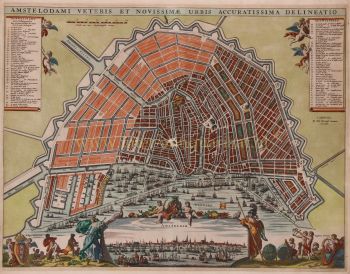
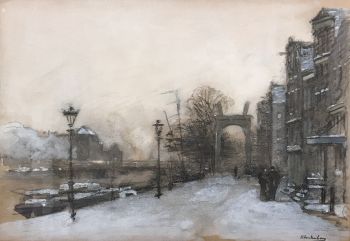
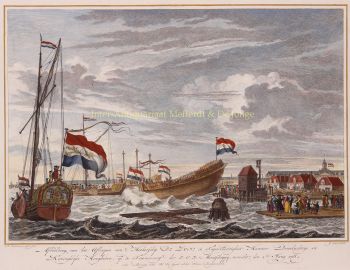
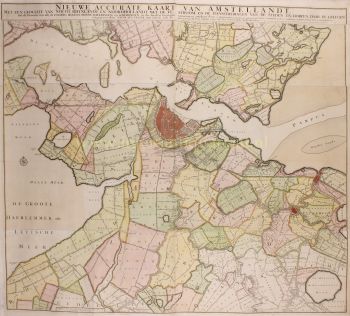
    BUSY 18TH CENTURY AMSTERDAM CANAL "Gezicht op de Binnen Amstel en Schut Sluys, ‘t Diaken Weeshuys nabij de Blauwe Brug vanaf de Amstelbrug gezien." [View of the inner Amstel river and lock, the orphanage near the Blauwbrug, seen from the Amstel Bridge." Etching with engraving printed from 2 copper plates, made by Daniël Stoopendael (1672-1726), published in Amsterdam by the Widow of Nicolaas Visscher around 1720. Coloured by a later hand. Size (plate):  approx. 57,8 x 94 cm. After the enlargement of the so called 'Grachtengordel' [today's canal district] with a fourth extention, a bridge was built over the Amstel in 1662, connecting the city walls on both sides of the river. The bridge had the same height as the ramparts, approx. six meters, and was therefore soon called 'Hogesluis' [high lock]. Here we see the Amstel river from this Hogesluis in a northerly direction to the Amstelsluizen, the Magere Brug (built in 1691) and the Blauwbrug. The Amstel locks were constructed to improve the water renewal of the tidal river Amstel and the so called 'Burgwallen'. This was to prevent the strongly increased pollution of the Amstel and the canals. Initially there were to be two locks, later this was changed to three: a large one in the middle and a smaller one on either side. At that time there was a sluice gate between the outer locks and the two Amstel quays. The wooden houses were used for the collection of municipal taxes. The brick house on the left was for the lock keeper. In the background, behind the Blauwbrug, we see the Diaconie Weeshuis (an orphanage), where the Stopera (town hall/opera building) is located today. On the right side of the Amstel (where there is a windmill), is the location of the Carré theater since 1887. This large print is from a series of 25 separately published cityscapes and provides a magnificent picture of life in Amsterdam at the beginning of the 18th century. Reference: Hollstein 11; auction R.W.P. de Vries 1925, lot no. 275; auction Leonhardt collection, Christie's 1989, lot no. 29. Price: Euro 4.250,-
  • Over kunstenaar

    Het kan voorkomen dat een kunstenaar of maker onbekend is.

    Voor sommige werken is het niet te bepalen door wie het gemaakt is of dat het is gemaakt door (een groep) ambachtslieden. Voorbeelden zijn beelden uit de Oudheid, meubels, spiegels of handtekeningen die vaak niet duidelijk of leesbaar zijn. Maar ook sommige werken zijn helemaal niet gesigneerd.

    Ook kunt u de volgende beschrijving vinden:

    •"Toegeschreven aan …." waarschijnlijk een werk van de kunstenaar maar niet zeker of gedeeltelijk

    •“Atelier van ….” of werkplaats van” een werk uitgevoerd in het atelier of atelier van de kunstenaar, eventueel onder zijn toezicht

    •“Cirkel van ….” een werk uit de periode van de kunstenaar die zijn invloed laat zien, nauw verbonden met de kunstenaar maar niet noodzakelijkerwijs zijn leerling

    •“Stijl van ….” of  “Volger van ….” een werk uitgevoerd in de stijl van de kunstenaar, maar niet noodzakelijk door een leerling; kan eigentijds of bijna eigentijds zijn

    •“Wijze van ….” een werk in de stijl van de kunstenaar maar van latere datum

    •"Na …." een kopie (van welke datum dan ook) van een werk van de kunstenaar

    •“Getekend…”,  “Gedateerd….”  of  “Ingeschreven” dan is het werk gesigneerd/ gedateerd/ ingeschreven door de kunstenaar. De toevoeging van een vraagteken duidt op een element van twijfel

    •"Met handtekening ...", "Met datum ...", "Met opschrift..." of “Draagt signatuur/datum/opschrift” dan is de handtekening/datum/opschrift toegevoegd door iemand anders dan de kunstenaar

Bent u geïnteresseerd om dit kunstwerk te kopen?