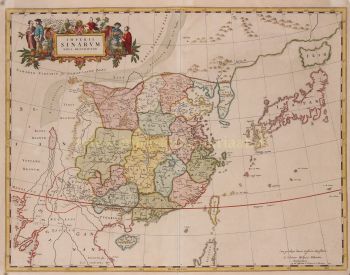
China, Korea, Japan - Mercator/Hondius, 1619 1619
Jodocus Hondius
Papier
34 ⨯ 47 cm
€ 2.150
Inter-Antiquariaat Mefferdt & De Jonge
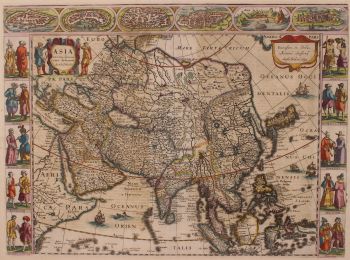
- Over kunstwerkONE OF THE MOST SOUGHT AFTER MAPS OF CHINA "China" Copper engraving made by Gerard Mercator published in Amsterdam by Jodocus II and Henricus Hondius in 1619. Verso Latin text. With original (?) hand colouring. Size: 34 x 47 cm. Of the lands in the Far East, China was seen as the wealthiest and most mysterious and the Jesuit missionairies were among the first to make the dangerous journey. Geographically the map is an interesting array of fact and fiction. The map contains rudimentary geographical information, as there was very little actually known of the region during the early part of the seventeenth century. The two most prominent features of this survey are the portrayal of the peninsula of Korea and the charming illustration China's great wall ((400 leagues in lenght, it protects the Chinese empire against the tartares), a wonder of both ancient and modern worlds. There is also a note porporting to be the location of "where the emperor of China has his seat". Despite the odd elongation of the country, there are attemps to show various provinces, and several great cities are marked. The interior of China is dominated by several large lakes and the mythical "Chiamai Lacus" forms the headwaters of five large rivers in northeastern India. The northwest coastline of America appears in the upper top corner with a notation that refers to (again) the Tartar hordes (and the deer and wolves) that inhabit the region. As ever in these early maps seamonsters stalk unwary ships and Hondius shows a European merchant sailing on what is labeled as "Chinensis Oceanus". This ocean is portrayed with an elaborate and beautiful pattern which attempts to portray the movement of the waves. The islands of Japan also feature on this beautiful map, together with the portrayal of how a Japanese 'criminal' is tied (ie not nailed) to a cross and is speared by a European for killing Christians. The persistance of the Jesuits wanting to spread Christianity in Japan, ultimately led to the fact that foreigners were driven out and from 1616 foreign trade (with the exception of China) was limited to the ports of Hirado and Nagasaki. (Where the Dutch - who were not missionaries, but traders - were the only ones to do business with Japan for more than two centuries.) On the left of the map is a land yacht (as is often the case on early depictions of China), with the note that the Chinese are an inventive people and that they had fabricated a wagon that could sail on the wind across the plains. Marco Polo swore were they in common use at the time. Jodocus Hondius (1563-1612) was the founder of the famous 17th century Dutch map publishing family. Hondius, along with sons Jodocus II and Henricus and son-in-law Jan Janssonius, was prominent in Dutch cartography and competed with the emerging Blaeu family map business. When Jodocus Hondius acquired the copperplates of Gerard Mercator's atlas, he prepared this map for inclusion in his Atlas sive Cosmographicae…, first published in 1606. This map is from the edition dated 1619 (Ref.: Koeman Me26B). Price: EUR 2.150,-
- Over kunstenaar
Jodocus Hondius (17 oktober 1563 – 12 februari 1612), ook bekend onder de gelatiniseerde vorm van zijn Nederlandse naam Joost de Hondt, was een Vlaamse graveur en cartograaf en een van de bepalende figuren van de Gouden Eeuw van de Nederlandse cartografie. Om hem van zijn zoon te onderscheiden, wordt hij vaak aangeduid als Jodocus Hondius de Oudere.
Hondius verwierf bekendheid door zijn uitzonderlijke vermogen om technische graveervaardigheid te combineren met geografische kennis. Hij is vooral bekend om zijn vroege en invloedrijke kaarten van Europa en de Nieuwe Wereld, die de visuele perceptie van nieuw ontdekte gebieden in Europa aan het begin van de zeventiende eeuw mede vormgaven. Zijn kaarten kenmerken zich door helderheid, precisie en rijke decoratieve details – kwaliteiten die ze zowel tot gezaghebbende wetenschappelijke documenten als tot zeer gewilde kunstwerken maakten.
Een cruciaal moment in Hondius' carrière was de verwerving van de originele drukplaten van Gerardus Mercator. In een tijd waarin Mercators reputatie tanende was, heruitgaf en breidde Hondius deze platen uit, waarbij hij zijn eigen herzieningen en de nieuw beschikbare geografische kennis integreerde. Deze actie blies niet alleen Mercators nalatenschap nieuw leven in, maar verzekerde ook de blijvende invloed ervan, wat leidde tot de beroemde Mercator-Hondius-atlassen die decennialang de Europese cartografie zouden domineren.
Naast het maken van kaarten was Hondius ook een begaafd portretgraveur. Zijn portretten van Francis Drake behoren tot de meest herkenbare afbeeldingen van de beroemde Engelse navigator en tonen Hondius' veelzijdigheid en culturele reikwijdte aan.
Als een van de centrale figuren van de Nederlandse Gouden Eeuw van de cartografie (ca. 1570-1670) speelde Hondius een cruciale rol in de vestiging van Amsterdam als het belangrijkste centrum van de cartografie in het zeventiende-eeuwse Europa. Zijn werk overbrugde kunst, wetenschap en handel en gaf vorm aan de manier waarop de wereld in kaart werd gebracht, begrepen en verbeeld. Jodocus Hondius de Oudere wordt tegenwoordig herinnerd als een meestergraveur, een vernieuwende uitgever en een belangrijke architect van de moderne cartografische geschiedenis.

Bent u geïnteresseerd om dit kunstwerk te kopen?
Artwork details
Related artworks
- 1 - 4 / 6
Peter Paul Rubens (follower of )
Portrait of a man dressed up as an oriental man1750 - 1850
Prijs op aanvraagGallerease Selected
Onbekende Kunstenaar
Antique Dutch still life flowers in vase1740 - 1800
Prijs op aanvraagGallerease Selected
Gobert Denis Chambon/ Jean Janvier, S.G. Longschamps
Magnificient antiek World map1754
€ 17.500Inter-Antiquariaat Mefferdt & De Jonge
Gecureerd doorDanny Bree
1 - 4 / 24- 1 - 4 / 24
Onbekende Kunstenaar
A Chinese famille verte ‘fishermen’ bowl, Kangxi period (1662-1722)1662 - 1722
Prijs op aanvraagMenken Works of Art
1 - 4 / 24Jean Metzinger
Cubist nude lying with bent leg, circa 19201910 - 1920
Prijs op aanvraagGallerease Selected
1 - 4 / 24- 1 - 4 / 12