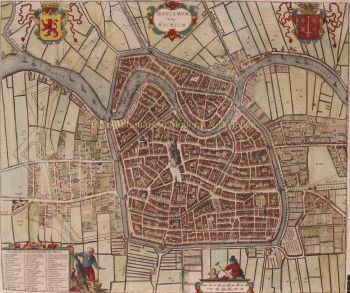
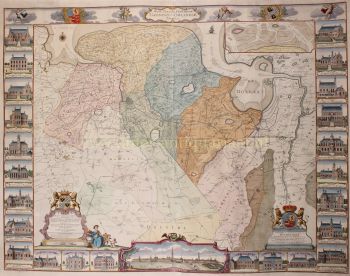
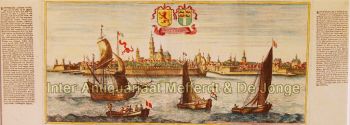
PLEASANT COUNTRY LIFE AROUND HAARLEM “Afteekening van de stad Haarlem in deszelfs Gragten, en eenige Hoofdstraaten; benevens deszelfs omtrek in de tegenwoordige situatie ten aanzien van de ligging der weegen, paden, hofsteden, buitens, gestichten, enz en De omtrek van Velzen… tot de Beverwyk… sluitende aan de kaart van de stad Haarlem en deszelfs omtrek” [Drawing of the city of Haarlem with its canals and some main streets; along with its surroundings in the current situation with regard to the layout of roads, paths, estates, country houses, institutions, etc., and the surroundings from Velsen... to Beverwijk... adjoining the map of the city of Haarlem and its surroundings.] Copper engraving made by Jan van Jagen in 1794, based on the design by Daniël Engelman. Coloured by a later hand. Size: 29.5 x 77.8 cm. About 250 years ago, the canals of Amsterdam and Haarlem offered a remarkable sight each year. Servants and maids lugged furniture, tableware, and all sorts of belongings from the canal houses into coaches and flat-bottomed boats. For passersby, all this activity was the signal that the “annual migration” had begun. Meanwhile, dozens of others were busy opening the shutters of the many country estates around Haarlem. The rooms were cleaned and the gardens put in order in preparation for the arrival of the master and lady of the house. In the seventeenth century, the “pleasant country life” had taken off. Those who could afford it fled the overcrowded cities of Amsterdam and Haarlem during the summer to enjoy fresh air, peace, and quiet in the leafy region of Kennemerland, the Gooi, or along the Amstel, Vecht, or Spaarne rivers. But that wasn't the only reason: anyone who wanted to be part of high society in Haarlem or Amsterdam had a country estate. It was a lifestyle their social standing demanded. This country life followed set rituals. Dirk Munter, the mayor of Amsterdam and proud owner of the Meervliet estate near Velsen, was expected to pay visits on certain days with his wife. Over a cup of tea—then still a luxury item—or a liqueur from Lucas Bols, stock market trends were discussed, marriages arranged, and gossip exchanged. Strolls were taken in the French-style gardens, where the latest botanical acquisitions—sometimes brought all the way from the West- or the East Indies —were admired in greenhouses and orangeries. For the men, an essential part of country life was the finch hunt. Finch hunting lanes could be found all along the edge of the dunes: at the estates of Leyduin, Boekenrode, Groot and Klein Bentveld, De Rijp, Sparrenheuvel, Saxenburg, and Wildhoef. Using decoy finches, the birds were lured into the lane, where a net was thrown, operated from a camouflaged finch house. The finches, thrushes, siskins, goldfinches, and sometimes a woodcock or partridge were then roasted and eaten. The catch was carefully recorded—if only to impress the guests. The finch book from Saxenburg in Bloemendaal, owned since 1784 by Amsterdammer Allard Mezen, recorded one day’s catch as: 1 woodcock, 300 thrushes, 170 finches, 117 larks. Naturally, everyone kept a close eye on the catch totals of other estate owners. In 1798, Mezen had to sell his thirty-hectare country estate due to poverty. The auction list noted that the large salon was decorated with gold leather wallpaper, the floors were covered with Smyrna carpets, many paintings adorned the walls, and the cupboards were filled with Asian porcelain. The estate, including its finch hunting lane, was sold for a mere pittance. Mezen’s fate was not unique, as the economy of the Dutch Republic went into steep decline after 1750. Price: Euro 1.450,-