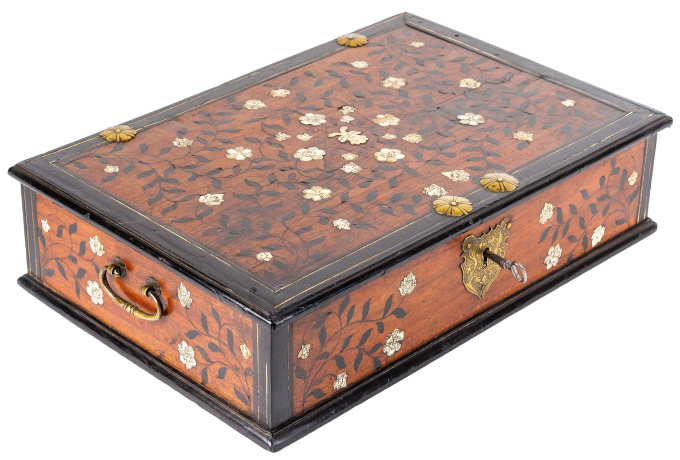
Indian colonial inlaid work box, 18th century 1700 - 1750
Artista Sconosciuto
ossoLegnaAvorioMetalloOttone
33 ⨯ 48 ⨯ 12 cm
ConditionGood
Prezzo su richiesta
Verkoulen Oriental & European Antiques
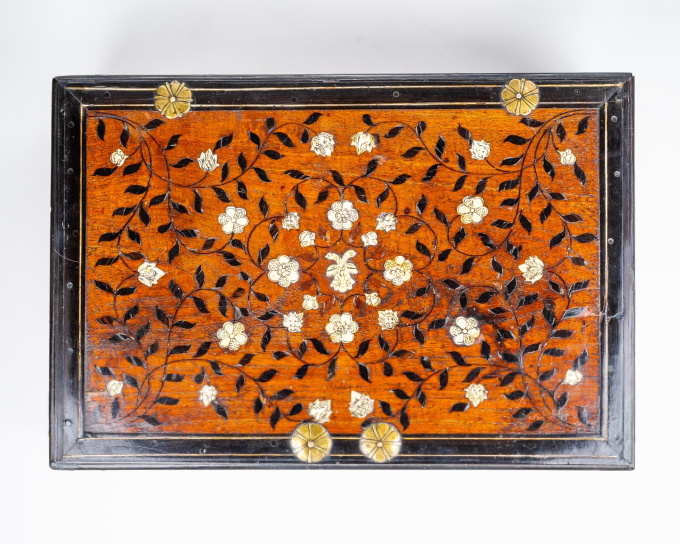
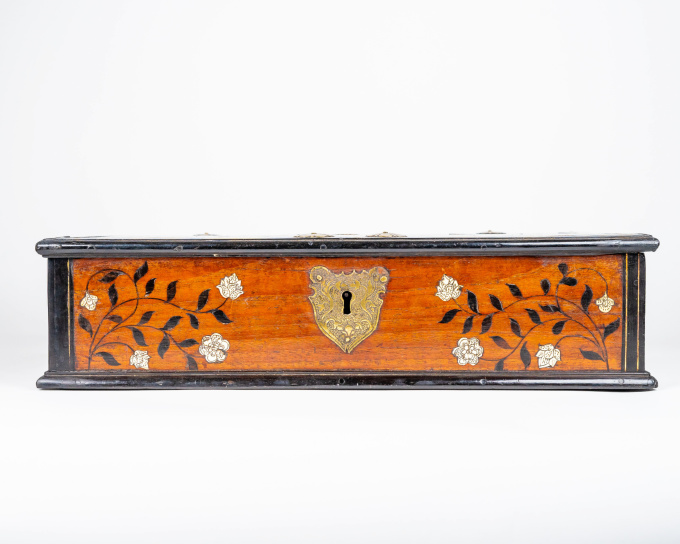
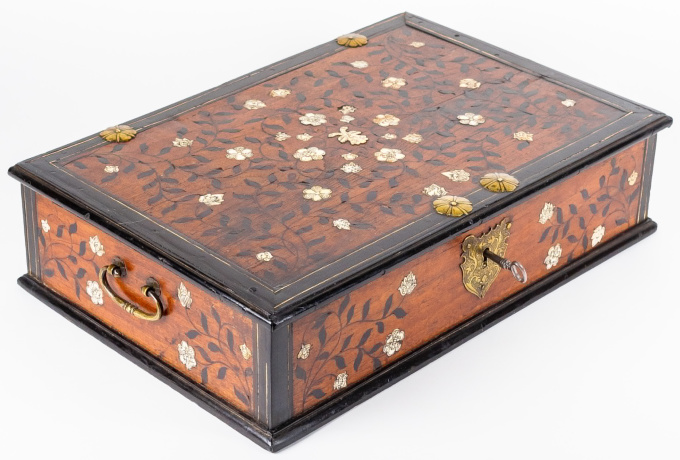
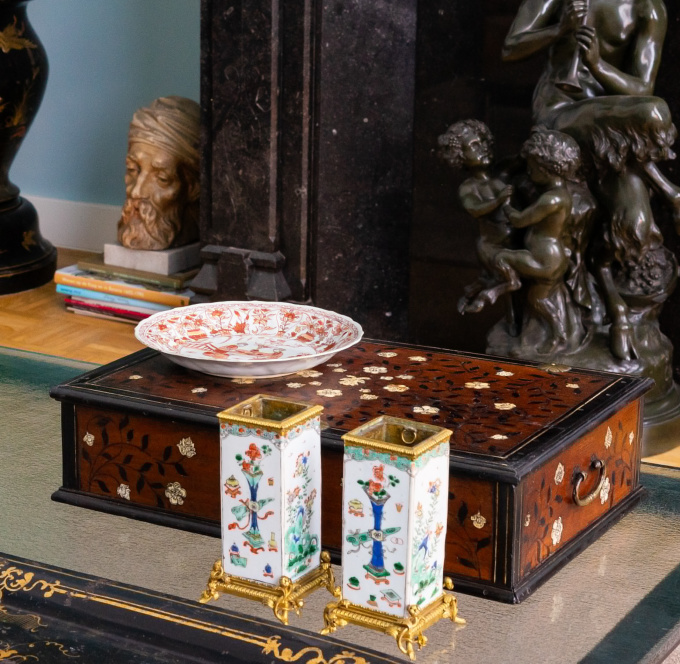
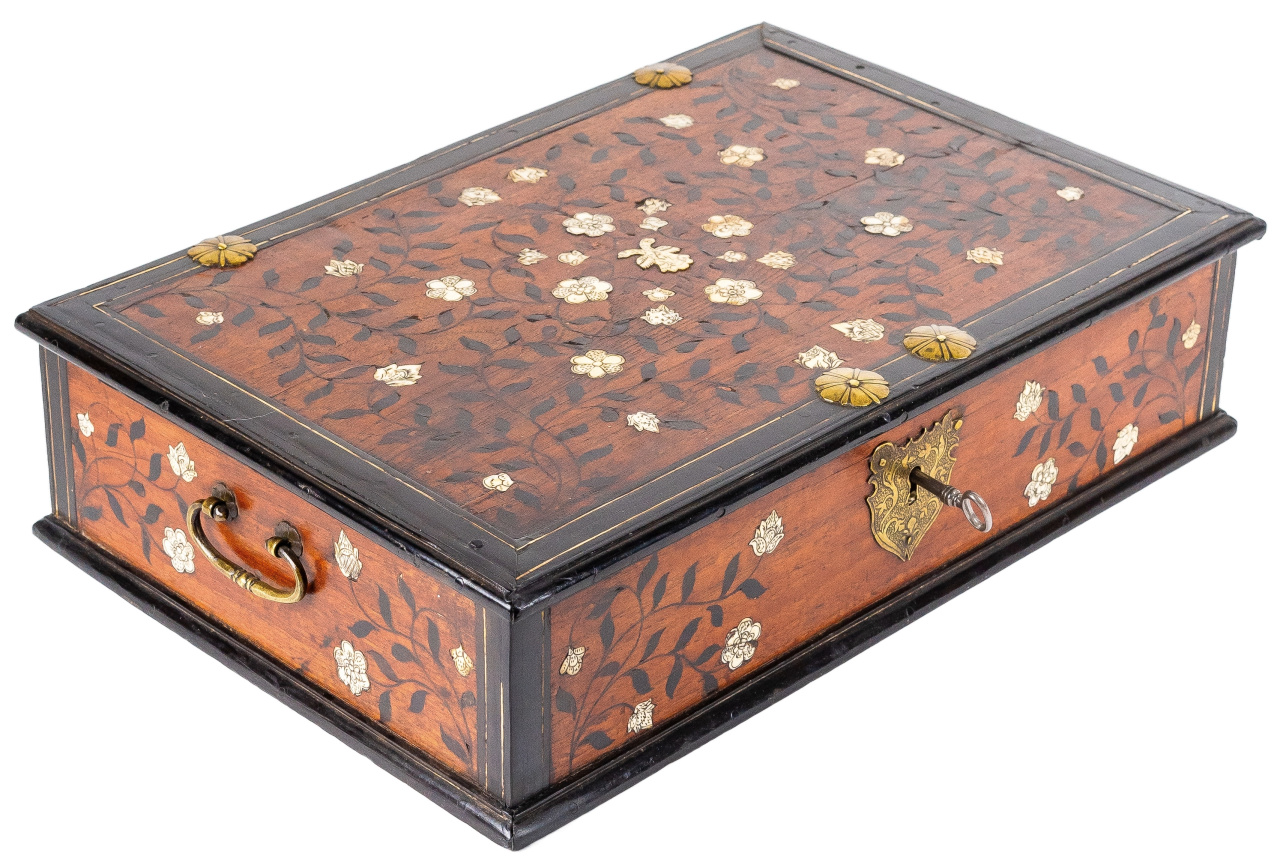
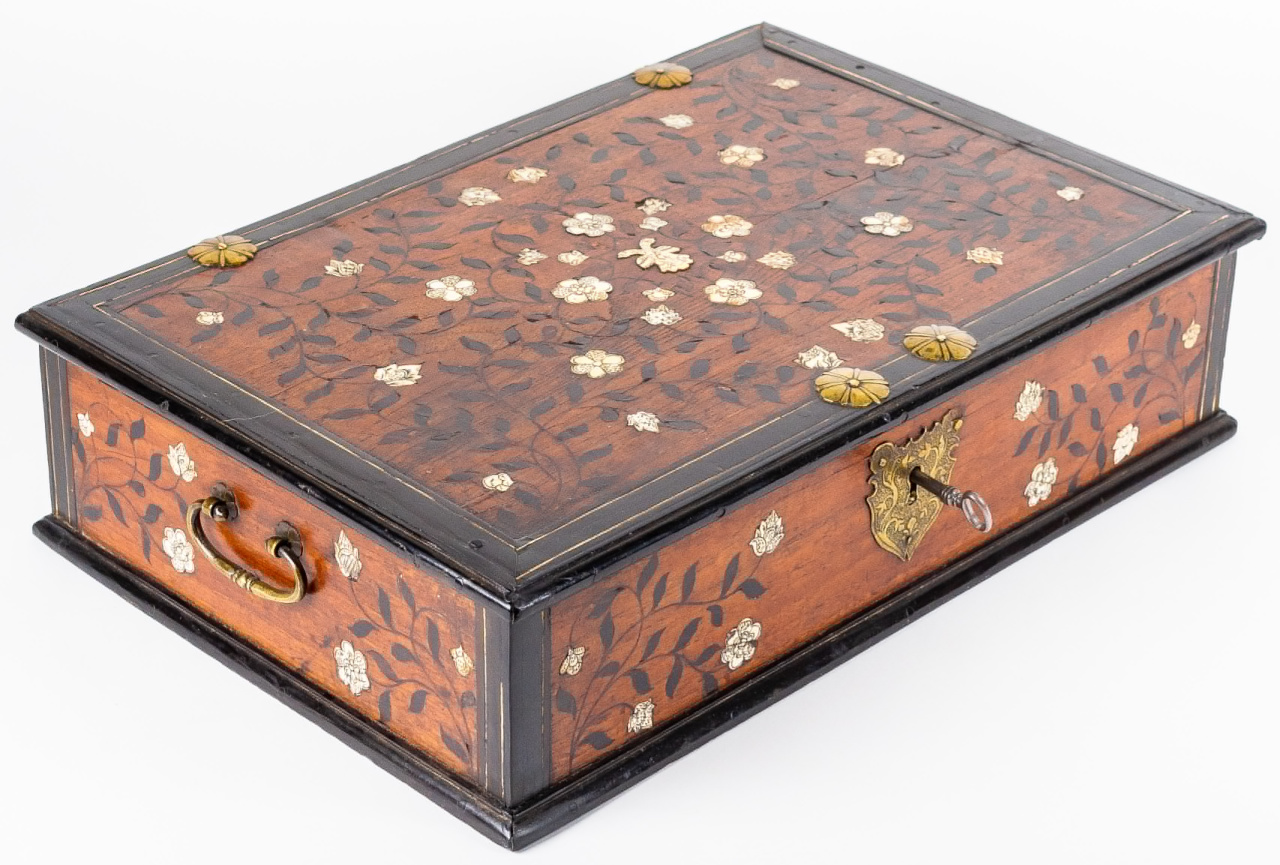
- A proposito di opere d'arteAn exotic (Anglo-)Indian work box made of teak and ebony with bone inlaid floral motifs, 18th century, around 1700-1750, Vizagapatam, India.
Dimensions: 32,5 x 47,5 x 12 cm.
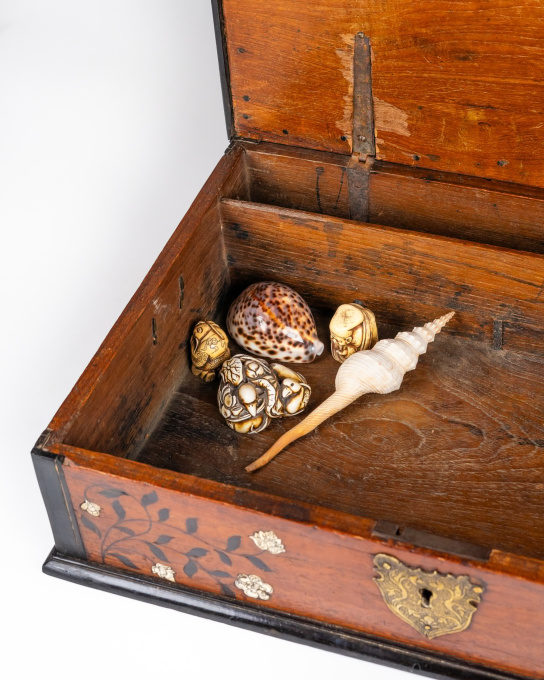
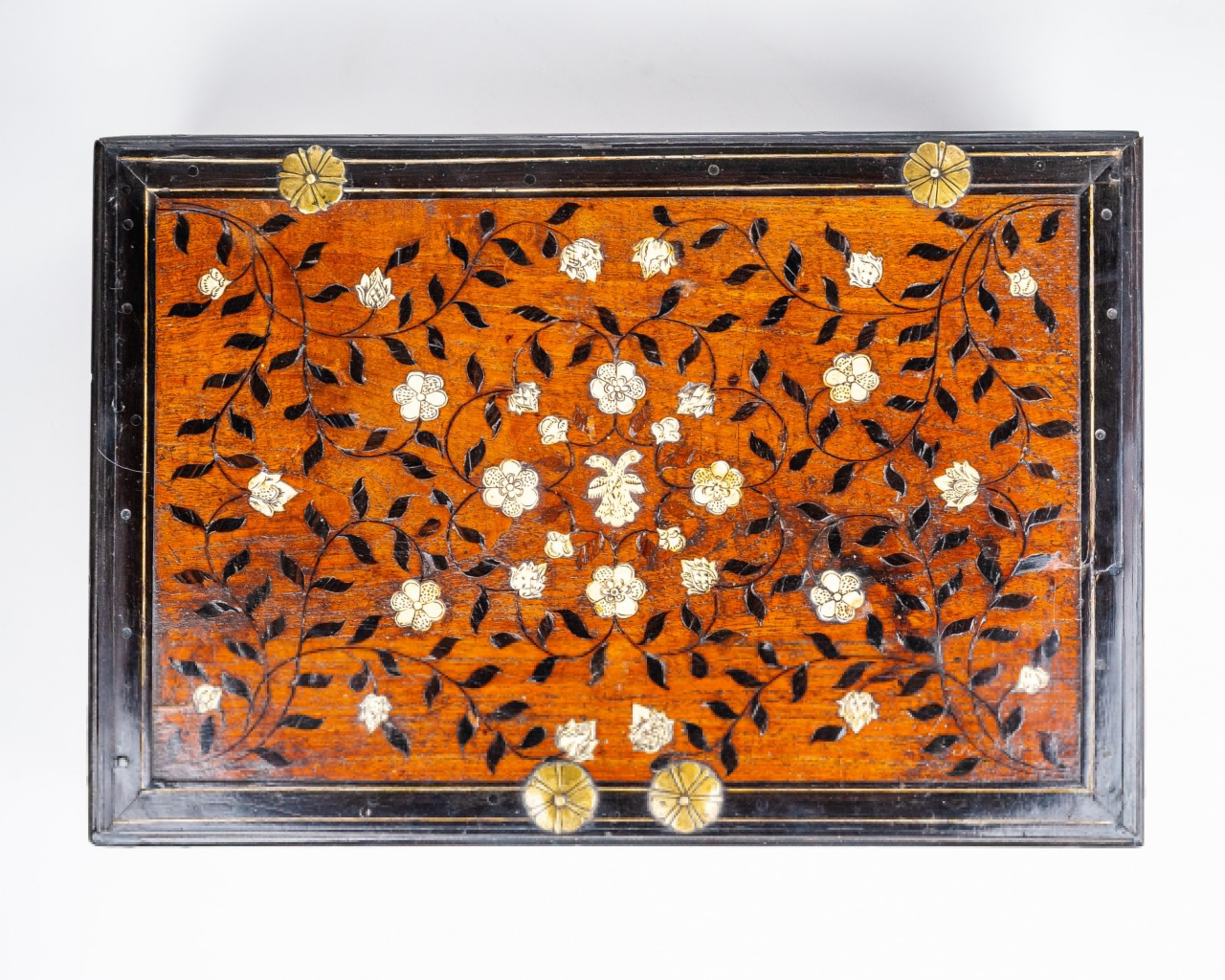
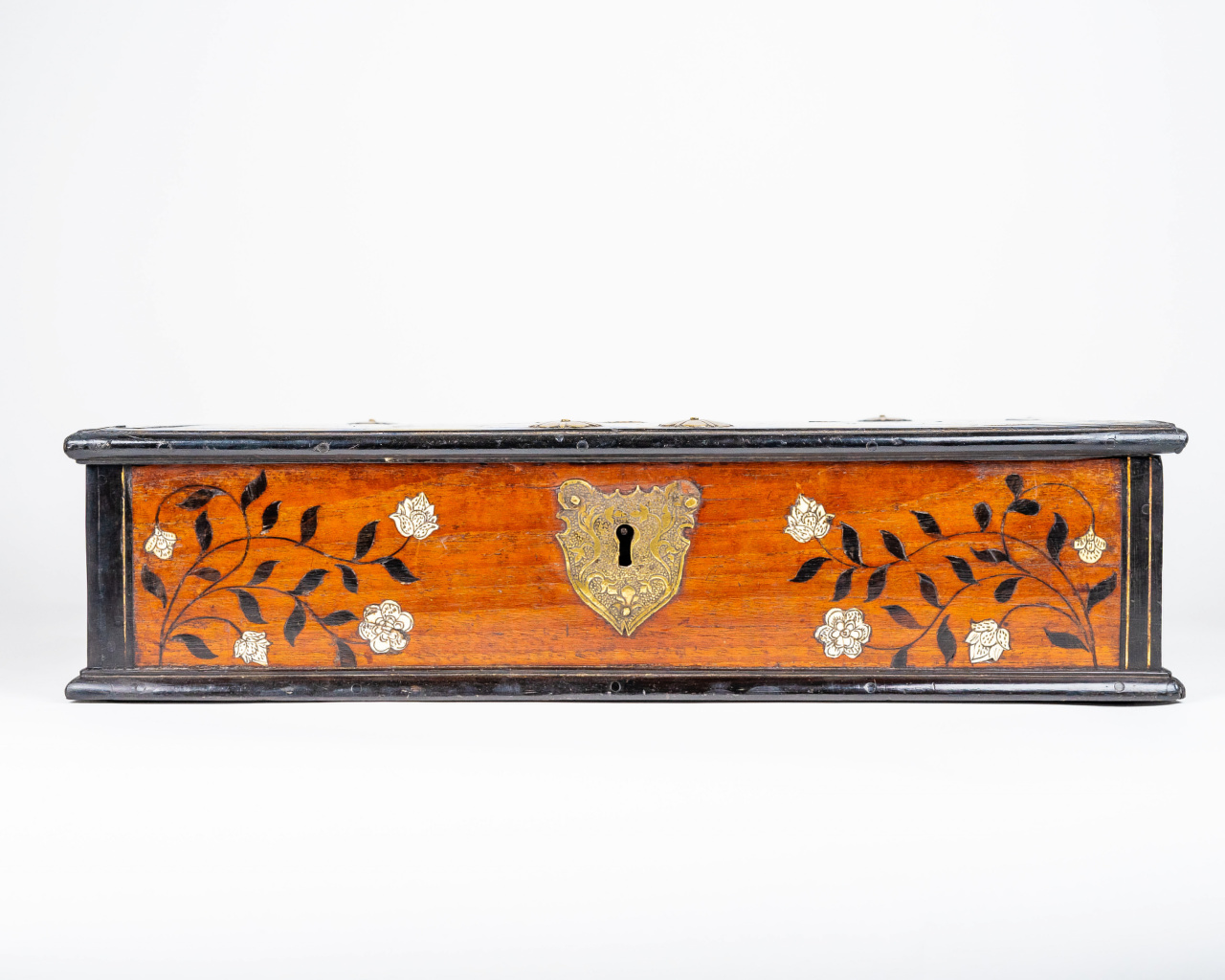
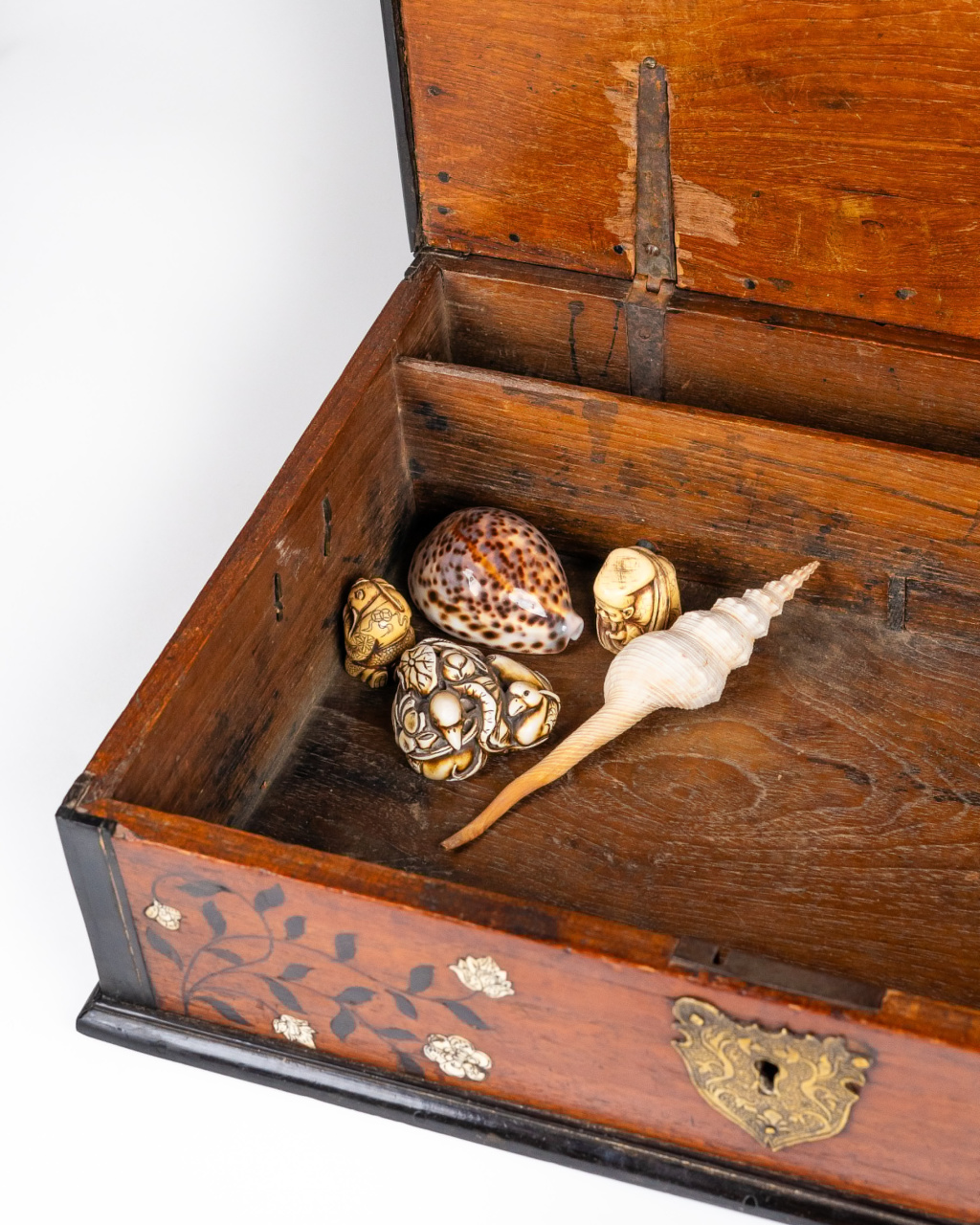
This larger document or work box is an example of typical early 18th century craftmanship influenced by the Europeans but also the Indian taste and culture. The brownish with darker veining rosewood is considered as a precious hardwood and perfect to withstand the warm and moistures climate of the Indian ocean region and Indonesian archipelago. The ivory is etched and filled with black lacquer to form a shade on the flower buds. The ‘scrolling vines’ created out of black leaves and stems of the flower are inlaid with ebony wood. The top lid had four studded floral rosettes, and the sides of the box have brass handles. The front is also provided with an elegant brass lock plate and a key. On the inside we can find several compartments to store writing materials.
Vizagapatam was a fundamental center for production of luxurious objects exported to Europe and other ports. It was a part of Madras Presidency (the administrative divisions of Madras, province of British India with St. George fort) from the 17th century till the independence in 1947. The first written reference to ivory inlayed furniture in Vizagapatam was made in 1756 by Major John Corneille, who noted that the area was known for the quality of its Chintz (processed fabric), which is “esteemed the best in India for the brightness of its colours”, and that "the place is likewise remarkable for its inlay work, and justly for they do it to the greatest perfection". The British East India Company had a textile factory in Vizagapatam from 1668. Eventually by 1768 the British gained control over the whole area. It was a tradition in Vizagapatam to manufacture furniture in Western style, using ivory etched with lacquer inlaid into wood. The decoration they used in Vizagapatam was inspired from the Mughal culture. Even though the British had control over Vizagapatam and other regions, objects produced in Vizagapatam during the 18th century were also made for company officials from Holland as wel as the European market.
Condition: Good, some wear to the inlay work.
For a similar example mounted on a later stand, see: Christie's 17 February 2016, Live auction 12033, lot nr. 267.
NOTE: Please note that the shipping time takes longer for this object, because the need of CITES-Documents for export! - A proposito di opere artista
Può succedere che un artista o un creatore sia sconosciuto.
Alcune opere non sono determinate da chi sono state realizzate o sono state realizzate da (un gruppo di) artigiani. Esempi sono statue dell'antichità, mobili, specchi o firme non chiare o leggibili ma anche alcune opere non sono affatto firmate.
Inoltre puoi trovare la seguente descrizione:
•"Attribuito a …." A loro avviso probabilmente opera dell'artista, almeno in parte
•“Studio di ….” o “Officina di” A loro avviso un'opera eseguita nello studio o nella bottega dell'artista, eventualmente sotto la sua supervisione
•“Cerchio di…” A loro avviso un'opera del periodo dell'artista che mostra la sua influenza, strettamente legata all'artista ma non necessariamente al suo allievo
•"Stile di..." o "Seguace di..." A loro avviso un'opera eseguita nello stile dell'artista ma non necessariamente da un allievo; può essere contemporaneo o quasi contemporaneo
•“Modalità di…” A loro avviso un'opera nello stile dell'artista ma di epoca successiva
•"Dopo …." A loro avviso una copia (di qualsiasi data) di un'opera dell'artista
•“Firmato…”, “Datato…” o “Iscritto” A loro avviso l'opera è stata firmata/datata/inscritta dall'artista. L'aggiunta di un punto interrogativo indica un elemento di dubbio
•"Con firma....", "Con data...", "Con iscrizione..." o “Riporta firma/data/iscrizione” a loro avviso la firma/data/iscrizione è stata aggiunta da qualcuno diverso dall'artista
Sei interessato ad acquistare questa opera d'arte?
Artwork details
Related artworks
- 1 - 4 / 12
Artista Sconosciuto
A pair of Dutch Colonial Solid Satinwood Chairs, Ceylon 18th century1725 - 1750
Prezzo su richiestaMenken Works of Art
1 - 2 / 2Artista Sconosciuto
EIGHT NEO-GOTHIC STAINED GLASS WINDOWS WITH SUSPENSION EYELET, 19th C, BELGIUM.1850 - 1900
Prezzo su richiestaSpectandum Gallery
Artista Sconosciuto
EIGHT NEO-GOTHIC STAINED GLASS WINDOWS WITH SUSPENSION EYELET, 19th C, BELGIUM.1850 - 1900
Prezzo su richiestaSpectandum Gallery
Artista Sconosciuto
A rare Sawasa ware book-form box and cover, Edo period, early 18th century1700 - 1750
Prezzo su richiestaMenken Works of Art
Børge Mogensen
Teak wood “dropleaf” desk – Søborg Møbler, Denmark circa 19551950 - 1960
Prezzo su richiestaVan Kerkhoff Art
1 - 4 / 24Roman & Henriëtte Reisinger
Tulips still life in glass jar2020
Prezzo su richiestaAtelier/ Galerie H&R Reisinger
1 - 4 / 24Linda Verkaaik
The Wave 15/20/30 cm - acrylic/ brass/RVS2020
Prezzo su richiestaGalerie Bianca Landgraaf
Alvar Aalto
A set of four ‘Käsikranaatti’ (Hand Grenade) pendants, model A110 – Louis Poulsen 1960’s1960 - 1969
Prezzo su richiestaVan Kerkhoff Art
1 - 4 / 24Artista Sconosciuto
Set Arita 'dog training' plates, 18th century 1700 - 1730
Prezzo su richiestaVerkoulen Oriental & European Antiques
1 - 4 / 5