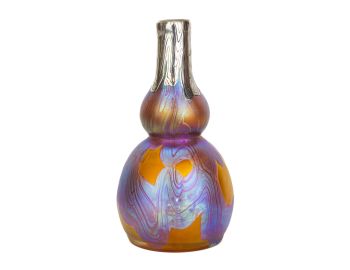
Johann Loetz Witwe – Ausfuehrung 134 with applied Cobalt Papillon snake by Johann Loetz (Lötz) Witwe Klostermühle

Johann Loetz Witwe – Ausfuehrung 134 with applied Cobalt Papillon snake 1914 - 1918

Johann Loetz (Lötz) Witwe Klostermühle

Glas
13 cm, ø 21 cm
ConditionExcellent
Prijs op aanvraag

Antiques Emporium

  • Over kunstwerk
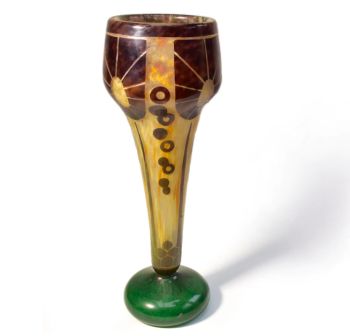
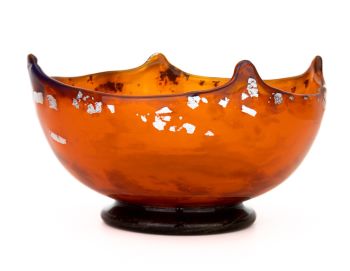
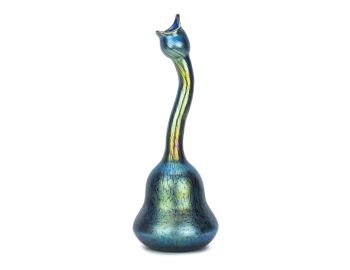
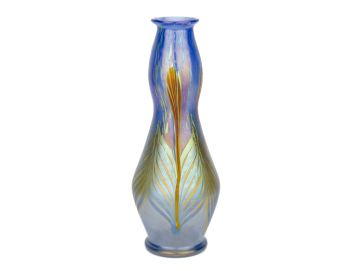
    This remarkable bowl was created by Johann Loetz Witwe and dates back to the early 20th century. With a generous body diameter of 21 cm (8.27 inches) and a height of 13.5 cm (5.31 inches), this is an impressive decorative object that reflects the transition from the Art Nouveau to the Art Deco era.

    The bowl is crafted in Ausführung 134, a technique introduced in 1914, at the onset of the First World War. This execution is based on the Titania technique, developed in 1905 as a response to the waning interest in iridescent glass. With Titania, Loetz introduced a new aesthetic by layering metallized glass threads over a base-colored glass and finishing it with a transparent glass coating. This process created a mysterious play of colors and a unique depth effect, giving the glasswork a refined and captivating appearance.

    In terms of color, the bowl features a stunning light blue base, combined with a deep blue-gray Titania layer. Unfortunately, photographs often fail to capture the true colors and nuances of the bowl, slightly understating its enchanting depth and play of colors.

    A distinctive feature of this bowl is the applied snake, crafted from cobalt blue glass. The graceful snake lies elegantly across the bowl, with carefully formed details such as a hand-shaped head and applied glass eyes. Additionally, the upper rim of the bowl is accentuated with a cobalt blue glass thread, further enhancing its refined appearance.

    As is customary for Loetz glass after 1902, the bowl is unsigned. After the First World War, Loetz introduced a new etched mark, “CZECHO-SLOVAKIA,” for their glassware, but this does not apply to this piece.

    This bowl combines artistic innovation and historical significance, making it a valuable object for both Art Nouveau enthusiasts and Loetz glass collectors.
  • Over kunstenaar

    Lötz/Loetz werd in 1840 opgericht door Johann Lötz en was een bedrijf gevestigd in Bohemen, in de Tsjechische Republiek, in de tijd dat Lötz tot het keizerrijk Oostenrijk-Hongarije behoorde. In 1879 nam een kleinzoon van Lötz, Max Ritter-Von Spaun, de zaak over van zijn grootmoeder en hield de naam Joh. Lötz Witwe.

    Vanaf dat moment begon Johann Lötz Witwe echt naam te maken, ze ontwikkelden nieuwe innovatieve glastechnieken, maar ook hun vormgeving en felle kleuren waren helemaal vernieuwend. Ze ontwierpen bijzondere vormen en vazen, luxe artikelen, die ze verkochten in luxe winkels in Wenen, Berlijn, Hamburg, Parijs, Londen, Milaan, Brussel en Madrid. Het maakte ze al snel zeer bekend en beroemd.

    Het was de periode dat de Art Nouveau of zoals dat in Duitsland Jugendstil genoemd werd, bloeide. Ze gebruikten organische vormen, de natuur was hun voorbeeld, ook voor Lötz ontwikkelden ze prachtige decors, gelijkend op vlindervleugels, zoals het papillondecor van deze vaas, vaak werden de vormen organisch gevormd door met een tang het hete glas ongelijk te vormen, evenals bloemen worden gevormd. Maar ook een octopus of zeeschelpen werden als voorbeeld genomen voor hun bijzondere vazen en decors.

    Lötz nam deel aan allerlei Wereldtentoonstellingen, waaronder de beroemde Wereldtentoonstelling van 1900 in Parijs waar ze de Grote Prijs wonnen. Ze werden bekroond met tal van prijzen voor deelname aan Wereldtentoonstellingen. Max Ritter von Spaun ontving ook speciale onderscheidingen voor zijn bijdrage aan de glasindustrie, in 1883 mocht hij de keizerarend in hun schild en zegel gebruiken, ze mochten ook K.K. Zet Private Glass Factory voor hun naam. In 1889 ontving hij ook een ridderschap van Franz Josef. Maar ook andere koningshuizen waren erbij betrokken. Hij ontving de Belgische Leopoldsorde en het eervolle Franse Legion d'Honneur.

    Hun ontwerpen vielen in de smaak, ook in de Verenigde Staten. Tiffany werkte met Lötz aan de set van Favril. Lötz patenteerde enkele van hun speciale technieken, zoals degene die ze gebruikten om het Phänomen-decor te maken. Ze waren in staat iriserend glas te maken. Kortom, Lötz was een begrip geworden. En dat is het nog steeds.

    Lötz werkte ook nauw samen met andere glasfabrikanten zoals J.&L. Lobmeyer en E. Bakolowits Söhne in Wenen en met Argentor. Daarnaast werkte Lötz nauw samen met verschillende kunstenaars, zoals Josef Hoffmann, Koloman Moser, Franz Hofstötter, Michael Powolny en andere kunstenaars van de Wiener Werkstätte. Michael Powolny was verantwoordelijk voor de veel strakkere tangovazen uit de jaren twintig.

    De Eerste Wereldoorlog en het einde van het Oostenrijkse rijk betekenden een moeilijke periode voor Lötz.
    Lötz heeft bestaan tot 1940, na een bombardement is de fabriek volledig afgebrand. Na de Tweede Wereldoorlog behoorde Tsjechië tot de satellietstaten van de Sovjet-Unie, de fabriek werd genationaliseerd totdat deze uiteindelijk in 1947 werd gesloten.

    Het glas van Lötz is nog steeds erg populair en wordt wereldwijd verzameld, daarnaast is hun oeuvre ook terug te vinden in vele museumcollecties.

Bent u geïnteresseerd om dit kunstwerk te kopen?