A Testament to Time: 400-Year-Old Diamond Cluster Ring 1600
Artista Desconhecido
Adin Fine Antique Jewellery
- Sobre arte
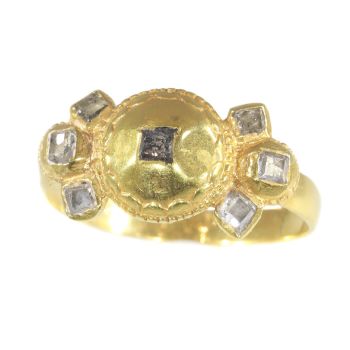
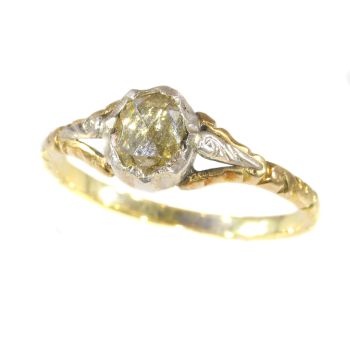
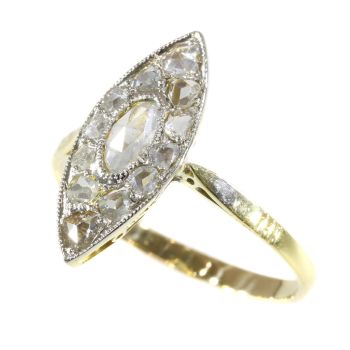
This remarkable 16th/17th-century diamond cluster ring captivates with its historical charm and intricate craftsmanship. Likely of northwestern European origin, it features nine table-cut rose diamonds set on foil, reflecting the early advancements indiamond cutting during the late 16th and early 17th centuries. The table cut, one of the first faceting techniques developed, is time-specific to this era and a key feature in jewellery from this period. The ring’s design embodies the spirit of its time, while the shank raises intriguing questions about whether it was born with the ring or replaced later in its long life. In the description below, we delve into the arguments surrounding this. Imagine owning and wearing a jewel that has endured for 400years, carrying with it centuries of untold stories and moments in history.
Antique jewelry object group
diamond cluster ring
Condition
good condition
more info on our condition scale
Country of origin
Although it does not carry any legible control marks we believe this to be of northwestern European origin (Dutch/Belgian)
Style
This ring exemplifies the stylistic essence of circa 1600, capturing the transitional zeitgeist of the time. While it doesn’t strictly belong to the Baroque or Renaissance movements, its design reflects the artistic trends and craftsmanship of that era.The piece resonates with the spirit of its time, blending elements from both periods without being distinctly tied to either.
The top part of the ring, dating to around 1600, showcases a use of stones that strongly links it to the era. However, it remains difficult to classify it as purely Baroque or Renaissance in style. Interestingly, the bottom part (shank) of the ring maybe from a slightly later period, though this is not definitive. The hallmarks found on the shank provide further clues, suggesting the possibility of different timelines for the ring’s components, adding to its intrigue and historical depth.
Find more info on Baroque and Renaissance or on all styles
Period
ca. 1600
Events & facts of this era, poetry of this era, fashion of this era.
Material 18K
yellow gold (touchstone tested)
more info on precious metals
Technique
The rose cuts are set on foil. This is a special technique that was used to bring the lustre of the diamonds to its best quality.
Extra information
As mentioned above, we cannot say with 100% certainty that the shank (also known as the band of the ring) originally belongs with the top part. It is not uncommon for the band to be replaced over time, and in this case, the gold color of the shankappears slightly more yellow compared to the reddish hue of the top part. However, this does not provide definite proof either, as the original goldsmith could have intended such a contrast. We will delve deeper into this in the section on the hallmarks.
Diamonds
Nine table cut rose cut diamonds.We do not have the weight of the diamonds which is normal in our trade when it comes to rose cuts.
- All diamonds, regardless of their size or shape, in our vintage and antique jewellery are verified as 100% natural by the IJGC laboratory.
- We do not sell lab-grown (synthetic) diamonds.
Birthstones
Diamond is the birthstone (or month stone) for April.
more info on birthstones
The hallmarks present on the shank include:
- A cornucopia (horn of plenty), used in the Southern Netherlands from 1815 to 1832, specifically for small gold works without attachments.
- A small Gothic "r," indicating a Belgian re-mark after 1830, applied to jewellery that was already in circulation before being submitted for re-inspection.
- An "L" with wavy lines above it, which stylistically suggests an 18th-century or potentially much earlier origin.
These hallmarks on the shank suggest a later date than the setting style and the use of table-cut rose diamonds would indicate. All of these marks are found (not unusually) only on the shank and not on the top part, so the assumption that the top part is older than the shank remains plausible.
more info on hallmarks
Dimensions
band width top of ring 1,47 cm (0,58 inch)
see picture with a ruler in millimeters and inches
Weight
3,70 gram (2,38 dwt)
Ring size Continental EU: 59 & 18¾ , Size USA: 8¾ , Size UK: R
Resizing
Free resizing (only for extreme resizing we have to charge).
more info on ring sizes
Adin Reference Nº
24278-0234
Copyright photography
Adin, fine antique jewellery
Additional information
our latest acquisitions
jewelry glossary
wall of fame
visit us in Antwerp
subscribe to our mailinglist
- Sobre artista
Pode acontecer que um artista ou criador seja desconhecido.
Algumas obras não devem ser determinadas por quem são feitas ou são feitas por (um grupo de) artesãos. Exemplos são estátuas dos tempos antigos, móveis, espelhos ou assinaturas que não são claras ou legíveis, mas também algumas obras não são assinadas.
Além disso, você pode encontrar a seguinte descrição:
•"Atribuído a …." Na opinião deles, provavelmente uma obra do artista, pelo menos em parte
• “Estúdio de…” ou “Oficina de” Em sua opinião um trabalho executado no estúdio ou oficina do artista, possivelmente sob sua supervisão
• "Círculo de ..." Na opinião deles, uma obra da época do artista mostrando sua influência, intimamente associada ao artista, mas não necessariamente seu aluno
•“Estilo de…” ou “Seguidor de…” Na opinião deles, um trabalho executado no estilo do artista, mas não necessariamente por um aluno; pode ser contemporâneo ou quase contemporâneo
• "Maneira de ..." Na opinião deles, uma obra no estilo do artista, mas de data posterior
•"Depois …." Na opinião deles uma cópia (de qualquer data) de uma obra do artista
• “Assinado…”, “Datado…” ou “Inscrito” Na opinião deles, a obra foi assinada/datada/inscrita pelo artista. A adição de um ponto de interrogação indica um elemento de dúvida
• "Com assinatura ….”, “Com data ….”, “Com inscrição ….” ou “Tem assinatura/data/inscrição” na opinião deles a assinatura/data/inscrição foi adicionada por outra pessoa que não o artista

Você está interessado em comprar esta obra de arte?
Artwork details
Related artworks
- 1 - 4 / 12
- 1 - 4 / 24
- 1 - 4 / 24
Artista Desconhecido
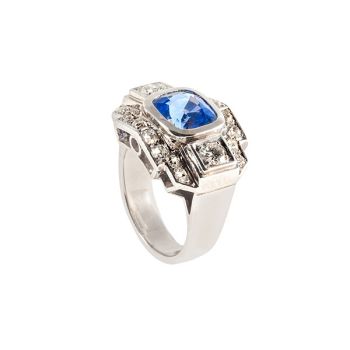
Anel retro em platina cravejado de diamantes e safira1940 - 1950
Preço em pedidoLyppens Juweliers
Ans Hemke-Kuilboer
Brincos de diamante solitair2000 - 2017
Preço em pedidoAns Hemke-Kuilboer Juwelier & Antiquair
1 - 4 / 24- 1 - 4 / 12


![RARE ARMORIAL MAP: LEO BRABANTIAE Lion of the most noble Duchy of Brabant] by Sibertus Waterloos](https://media-3.gallerease.com/images/325cc033-a3b6-495f-9da8-6d06caf29b14/350x350/rare-armorial-map-leo-brabantiae-lion-of-the-most-noble-duchy-of-brabant.jpg)