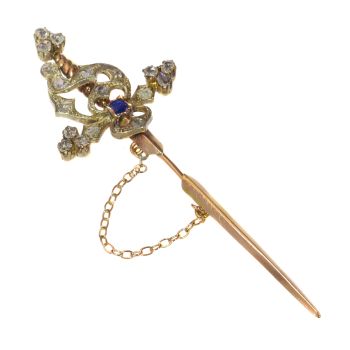
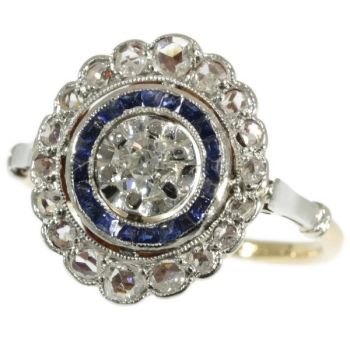
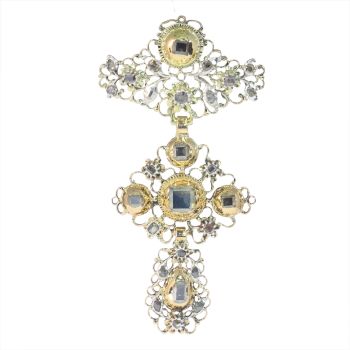
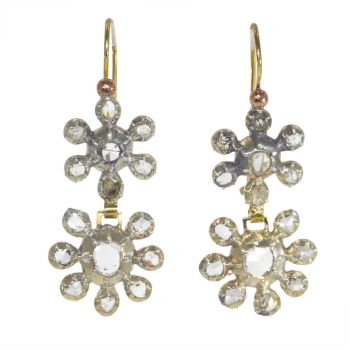
Crowned Victorian Blackamoor Stickpin Set with Rose Cut Diamonds, c.1870 by Artista Desconhecido

Crowned Victorian Blackamoor Stickpin Set with Rose Cut Diamonds, c.1870 1870

Artista Desconhecido

DiamanteOuroGemstone
€ 3.750

Adin Fine Antique Jewellery

  • Sobre arte

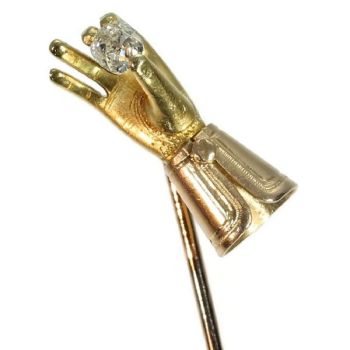
    This Victorian stickpin from around 1870 presents a finely modelled blackamoor bust crowned and adorned with shimmering rose cut diamonds. The darkened metal and warm gold provide a striking contrast, giving the figure a gentle gravitas that feelsrooted in the Grand Victorian taste for exotic motifs. Its sculptural quality suggests the hand of an artisan attentive to expression and movement, making it a small yet evocative relic of its period.

    Jewellery Type
    tiepin or stick pin

    Condition
    very good condition
    more info on our condition scale

    Country of origin
    unknown

    Style
    Victorian - Victorian decorative arts refers to the style of decorative arts during the Victorian era. The Victorian era is known for its eclectic revival and interpretation of historic styles and the introduction of cross-cultural influences from themiddle east and Asia in furniture, fittings, and Interior decoration. Victorian design is widely viewed as having indulged in a regrettable excess of ornament. The Arts and Crafts movement, the aesthetic movement, Anglo-Japanese style, and Art Nouveaustyle have their beginnings in the late Victorian era.
    See also: Victorian
    more info on styles

    Style specifics
    The Grand Victorian Period - Experts divide the reign of Queen Victoria, also called The Victorian era (1837 - 1901) into three periods of about twenty years each; The Romantic Victorian Period (1837 - 1860), The Grand Victorian Period (1860 - 1880),and the Late or Aesthetic Victorian Period (1880 - 1901).

    We consider this to be of the Grand Victorian Period.

    This second Victorian period is famous for its ostentatious pieces set with pearls and diamonds (from South Africa). From ca. 1850 wealthy English had reported about jewelry from India and Japan, which heavily inspired the jewelers of this period. Thisperiod also corresponds with the death of Queen Victoria's husband King Albert making mourning jewelry (set with heavy dark stones) the type of jewelry specific for this period.

    Period
    ca. 1870
    Events & facts of this era, poetry of this era, fashion of this era.

    Theme
    crowned blackamoor

    Material 18K
    white gold and silver (touchstone tested)
    more info on precious metals

    Extra information
    Blackamoors have a long history in decorative art, stretching all the way back to 17th century Italy and the famous sculptor Andrea Brustolon (1662–1732). They are often recognized for depictions of slaves and the ornamental pieces that they inspired.

    Diamonds
    Thirteen rose cut diamonds and senailles. A senaille is a simplified rose cut diamond, a small diamond chip with perhaps a few polished facets. We do not have the weight of the rose cuts diamonds nor the senailles which is normal in our trade when it comes to rose cut diamonds and senailles. - All diamonds, regardless of their size or shape, in our vintage and antique jewellery are verified as 100% natural by the IJGC laboratory.

    - We do not sell lab-grown (synthetic) diamonds.

    Birthstones
    Diamond is the birthstone (or month stone) for April.
    more info on birthstones

    Hallmarks
    No trace.
    more info on hallmarks

    Dimensions
    head 2,68 cm (1,06 inch) x 1,02 cm (0,40 inch), total length 8,25 cm (3,25 inch)
    see picture with a ruler in millimeters and inches

    Weight
    5,00 gram (3,21 dwt)

    Adin Reference Nº
    25321-0230

    Copyright photography
    Adin, fine antique jewellery

    Additional information
    our latest acquisitions
    jewelry glossary
    wall of fame
    visit us in Antwerp
    subscribe to our mailinglist

  • Sobre artista

    Pode acontecer que um artista ou criador seja desconhecido.

    Algumas obras não devem ser determinadas por quem são feitas ou são feitas por (um grupo de) artesãos. Exemplos são estátuas dos tempos antigos, móveis, espelhos ou assinaturas que não são claras ou legíveis, mas também algumas obras não são assinadas.

    Além disso, você pode encontrar a seguinte descrição:

    •"Atribuído a …." Na opinião deles, provavelmente uma obra do artista, pelo menos em parte

    • “Estúdio de…” ou “Oficina de” Em sua opinião um trabalho executado no estúdio ou oficina do artista, possivelmente sob sua supervisão

    • "Círculo de ..." Na opinião deles, uma obra da época do artista mostrando sua influência, intimamente associada ao artista, mas não necessariamente seu aluno

    •“Estilo de…” ou “Seguidor de…” Na opinião deles, um trabalho executado no estilo do artista, mas não necessariamente por um aluno; pode ser contemporâneo ou quase contemporâneo

    • "Maneira de ..." Na opinião deles, uma obra no estilo do artista, mas de data posterior

    •"Depois …." Na opinião deles uma cópia (de qualquer data) de uma obra do artista

    • “Assinado…”, “Datado…” ou “Inscrito” Na opinião deles, a obra foi assinada/datada/inscrita pelo artista. A adição de um ponto de interrogação indica um elemento de dúvida

    • "Com assinatura ….”, “Com data ….”, “Com inscrição ….” ou “Tem assinatura/data/inscrição” na opinião deles a assinatura/data/inscrição foi adicionada por outra pessoa que não o artista

Você está interessado em comprar esta obra de arte?