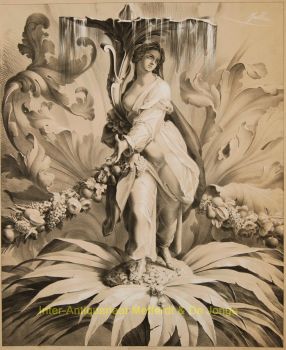
Anatomy - Jan Wandelaar after Bernhard Siegfried Albinus 1742 - 1747
Artiste Inconnu
ImprimerGravure
62 ⨯ 47 cm
€ 1.250
Inter-Antiquariaat Mefferdt & De Jonge
- Sur l'oeuvre d'artMAGNIFICENT PLATES FROM THE MOST ARTISTICALLY PERFECT ANATOMICAL ATLAS Copper engravings made between 1739-1743 by Jan Wandelaar for Bernhard Siegfried Albinus‘ famous “Tabulae Sceleti et Musculorum Corporis Humani” published in 1747 in Leiden by Johan and Herman Verbeek. Size: 62 x 47,5 cm (each). Tabulae Sceleti et Musculorum Corporis Humani was arguably the most important illustrated anatomical work of the Eighteenth Century. Anatomist Bernhard Siegfried Albinus (1697-1770) who was professor at Leiden university, and engraver Jan Wandelaar (1690–1759) collaborated closely to create engravings that were scientifically accurate and exceptionally visually appealing. In an attempt to increase the scientific accuracy of anatomical illustration, Albinus and Wandelaar devised a new technique of placing nets with square webbing at specified intervals between the artist and the anatomical specimen and copying the images using the grid patterns. Albinus believed in the idea of "homo perfectus", an idealized perfect human model based on which all humans were derived as variants. In order to represent this perfect human, the illustrations were drawn from multiple specimens. Earlier anatomical depictions such as those accompanying Andreas Vesalius' work (which Albinus had edited earlier) were drawn from single specimens. The anatomical figures were placed in lush, elaborate Baroque landscapes and architecture, giving the figures a spatial context, added aesthetic interest, and created an illusion of vitality. Wandelaar made the first prints in 1742, including depictions of skeletons with a rhinoceros. Which was the famous Indian rhinoceros Clara, who was staying in Leiden at the time and was immensely popular. Tabulae was criticized by such scholars as Petrus Camper, especially for the whimsical backgrounds, but Albinus staunchly defended Wandelaar. Wandelaar made the first of the plates in 1742, well before the publication of the Tabulae, and this included the skeleton superposed in front of a rhinoceros. This was the famous rhinoceros Clara which at that time stayed in Leiden and was extremely popular. Albinus believed so strongly in the work that he is said to have spent 24,000 florin -about €1,9 million today- to produce it. His investment provided plates that are incomparable and widely considered to rank among the best in engraving history. Prior to meeting Albinus, Jan Wandelaar was already an accomplished natural history artist. He studied with Dutch printmaker Jacob Folkema, Dutch engraver and mapmaker Willem van der Gouwen, painter Gérard de Lairesse, and botanist and anatomist Frederik Ruysch. From 1746 until his death, Wandelaar lived in Albinus's house. Price: Euro 1.250,- (each)
- Sur l'artiste
Il peut arriver qu'un artiste ou un créateur soit inconnu.
Certaines œuvres ne doivent pas être déterminées par qui elles sont faites ou elles sont faites par (un groupe d') artisans. Les exemples sont des statues de l'Antiquité, des meubles, des miroirs ou des signatures qui ne sont pas claires ou lisibles, mais aussi certaines œuvres ne sont pas signées du tout.
Vous pouvez également trouver la description suivante :
•"Attribué à …." A leur avis probablement une oeuvre de l'artiste, au moins en partie
•« Atelier de …. ou « Atelier de » À leur avis, une œuvre exécutée dans l'atelier ou l'atelier de l'artiste, éventuellement sous sa direction
•« Cercle de… ». A leur avis une oeuvre de la période de l'artiste témoignant de son influence, étroitement associée à l'artiste mais pas forcément son élève
•« Style de … ». ou "Suiveur de ...." Selon eux, une œuvre exécutée dans le style de l'artiste mais pas nécessairement par un élève ; peut être contemporain ou presque contemporain
•« Manière de… ». A leur avis une oeuvre dans le style de l'artiste mais d'une date plus tardive
•"Après …." A leur avis une copie (quelle qu'en soit la date) d'une oeuvre de l'artiste
•« Signé… », « Daté… ». ou « Inscrit » À leur avis, l'œuvre a été signée/datée/inscrite par l'artiste. L'ajout d'un point d'interrogation indique un élément de doute
• "Avec signature ….", "Avec date ….", "Avec inscription …." ou "Porte signature/date/inscription" à leur avis la signature/date/inscription a été ajoutée par quelqu'un d'autre que l'artiste

Êtes-vous intéressé par l'achat de cette oeuvre?
Artwork details
Related artworks
- 1 - 4 / 12
Vincent Laurensz van der Vinne
Portrait of a man and woman1640 - 1650
Prix sur demandeArt Gallery Voûte
Artiste Inconnu

Dutch School pair of equestrian paintings 1650 - 1750
Prix sur demandeGallerease Selected
1 - 4 / 24- 1 - 4 / 24
- 1 - 4 / 24
- 1 - 4 / 24
- 1 - 4 / 12


![“Tentation” [temptation], lithograph by Eugène Grasset](https://media-3.gallerease.com/images/b891f1b8-508a-4829-a559-a56b7f765ca7/350x350/tentation-temptation-lithograph.jpg)