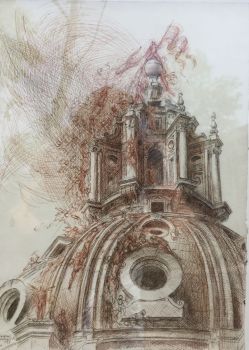
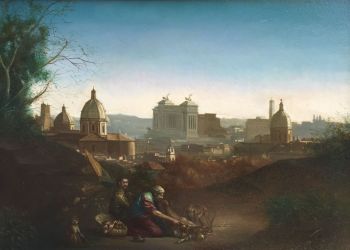
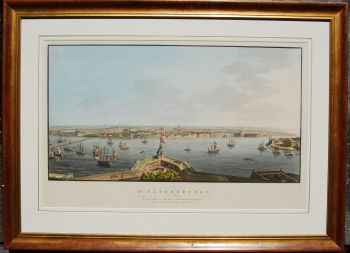
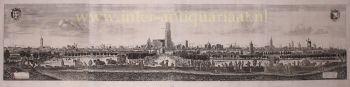
17TH CENTURY ROME “Roma”, copper engraving made by Clement de Jonghe and published by Frederick de Wit in Amsterdam around 1680. Coloured by a Size: approx. 40,5 x 50 cm. When the copper plates of art dealer Clement de Jonghe (ca. 1624-1677) were auctioned in 1679, this particular plate was bought by Frederick de Wit, who soon after published the view of Rome under his own name. 17th century Rome was a bustling city that had experienced significant urban development and artistic flourishing under the patronage of various popes. The city's architectural landscape was dominated by the Baroque style, characterized by its grandeur and elaborate ornamentation. At the heart of Rome stood St. Peter's Basilica, a magnificent symbol of Catholicism and the center of the Papal States. The basilica, on the far right of the engraving, had undergone significant renovations and expansions over the centuries, with the construction of the iconic dome designed by Michelangelo. The city was adorned with numerous other churches and religious buildings, showcasing the talent and creativity of renowned architects and artists. Churches like Sant'Ivo alla Sapienza and Sant'Agnese in Agone exemplified the exuberance and elegance of the Baroque style. Rome's squares and public spaces were transformed during this period. The famous Piazza Navona, with its magnificent fountains and obelisk, became a hub of activity and entertainment. The square was adorned with sculptures and embraced a vibrant atmosphere, attracting locals and visitors alike. The papal palaces, such as the Quirinal Palace and the Palazzo Barberini, showcased the wealth and power of the popes. The cultural scene in Rome was thriving. Artists, poets, and musicians flocked to the city, seeking inspiration and patronage from wealthy individuals and the papal court. Rome served as a meeting point for artistic exchange and innovation, attracting renowned painters, sculptors, and architects. The works of Caravaggio, Annibale Carracci, and Bernini exemplified the artistic brilliance of the period. Rome's intellectual circles were also vibrant. The city hosted prestigious universities, including the renowned Sapienza University, which attracted scholars from various disciplines. Scientific discoveries and advancements were taking place during the Scientific Revolution, with figures like Galileo Galilei contributing to the fields of astronomy and physics. Despite its cultural and artistic splendor, Rome faced challenges. Political instability and power struggles occasionally disrupted the city's harmony. Additionally, periodic outbreaks of the plague affected the population, leading to social and economic difficulties. The poems in Latin, Dutch and French below the view also mention that in spite of its splendor Rome is undergoing changes: “Beautiful Rome, in short, the princess of the world, The ornament of Europe, and the school of the arts. The heroine of old, second to none, Made herself invincible in battle, and hazards; But time has eaten away at her heart; The vengeful Rome is vanquished by herself, And lies dead within her own walls, So the old goes to naught and the new takes a start.” Price: Euro 2.150,-